Showing posts with label french. Show all posts

Saturday, 10 May 2014

Rupa & The April Fishes

Born to Indian parents in California, raised in the US, India & southern France, and leading a double life as musician & doctor, singer/guitarist/composer Rupa Marya and her “polyglot band of musical renegades” concoct an enchanting mix of French nouvelle vague, rousing Latin grooves, Gypsy swing, and dreamy Indian ragas. And to top it all, I just love their intelligent lyrics.


Une Americaine à Paris (An American Woman in Paris)

Guy in the Background:
 
there are not really differences, I think they are social constructions, we have all the same motivations, the same desires and it's a story of connecting...
a story of speaking, of changing ideas and realizing... 
that seems to me the most important thing, and tomorrow morning, you will be smiling

Main Lyrics:
after some days in silence
I did not say a word
and then I met you here in paris
sitting next to me in a bar
you just came from Algiers
and I from San Francisco
the world is crazy between us
you asked
aren't you afraid to be an American woman in Par
is 
with all these angry Arabs
I said no, I'm not American
you are not Arab and we are not in Paris
the world is crazy between us
what do you think of this?
what do you think of all these stories?
these stories, these stories make us crazy
you wanted to take your photo with me
I said no thank you, no photo
I prefer life
I'm not American
you're not Arab and we are not in Paris
we are in life
the world is crazy between us
what do you think, what do you think, what do you think  
what do you think of all this
what do you think of all these stories?
these stories, these stories make us crazy


Trouble


well i've had a fine fine time
but now the moon and its strange light
have put a question on the table
and i know you know what i mean
i can see it in your eyes as they catch upon
something in me
oh that thing is trouble
oh trouble, yeah trouble, beautiful trouble
why don't you stay
i think that you should go
woah, woah
now don't you think that i don't find
everything about you so divine
but just one more moment here and
i'll be through
it's not your fault
and it's not mine
it's the moon and the sweet light
she brings tonight
oh my love, can't you see
she brings trouble
oh trouble, yeah trouble, beautiful trouble
the more i try to explain
the less i know
woah, woah, oh
(Instrumental)
well, it takes 1 to know one
and it takes 2 to tango
and it takes just a count to 3 to fall
out of time out of time
and the ground starts to dissolve
oh my love can't you see
i'm in trouble
oh trouble, yeah trouble, beautiful trouble
the more i try to explain
the less i know
yeah trouble, yeah trouble, sweet sweet trouble
where do i go i don't know
where do i go
woah, woah

Plus Que Moi (More than me)


Oh ma pauvre tete (oh my poor head)
peut pas comprendre toutes ces choses (can't understand all these things)
esclave de mes pensées betes (slave of my stupid thoughts)
enfermée par les histoires que je compose (enclosed by the stories that I write)
chaque matin, chaque soir (every morning, every evening)
poursuivie par l'idée qu'll faut que je m'explique (pursued by the idea that I must explain myself)
et j'essaie avec des histoires mais (and I try with these stories but)
quoi que je dise je ne dis rien (whatever I might say, I say nothing)
et quoi que je sache je ne sais rien (and whatever I might know, I know nothing)

Donc je les lance dans le fleuve (Therefore, I throw them into the river)
toutes ces histoires qui m'énervent (all these stories that annoy me)
et vois celles qui flottent ou s'enfoncent (and watch which ones float or sink)
parce que le fleuve est plus sage que moi (because the river is wiser than I am)

Et aussi mon estomac (And also my stomach)
devient entortillé autour de mes idées (become entwined around my ideas)
essayant de faire les choses plus nettes (trying to make things clearer)
je trouve que je les fais plus melées (I find that I make them more complicated)

Chaque matin, chaque soir (Every morning, every evening)
je me demande c'est quoi la verité (I ask myself what the truth is)
et j'essaye avec des histoires mais (and I try with these stories but)
quoi que je dise ce n'est pas ca (whatever I might say, it's not that)
c'est pas à moi de raconter ce que l'on ne peut pas (it's not up to me to tell what I cannot)

Donc je les jette dans le ciel (Therefore I throw them into the sky)
moi pieds sur terre tenant le bout de la ficelle (me, feet on the ground, holding the end of the kite)
et vois celles qui tombent ou s'envolent (and I watch which ones fall or fly away)
parce que le ciel est plus honnete que moi (because the sky is more honest than me)

Et quoi que je dise je ne dis rein (And whatever I might say, I say nothing)
et quoi que je sache je ne sais rien (and whatever I might know, I know nothing)
je les raconte a la lune (I tell them to the moon)
ici toute seule, toute la nuit (here, all alone, all night)
et apprends d'elle de la folie (and I learn from her of madness)
parce que la lune sourit plus que moi (because the moon smiles more than me)

Yaad (Memory)
 

Tuesday, 26 February 2013

Six Primitive Egos in 'Le Petit Prince'

Before the Little Prince arrives in the desert on planet Earth, and meets the narrator-aviator representing the author Antoine de St. Exupéry, he visits six other planets. Each of these planets is inhabited by a primitive ego, a single adult character who has lost the innocence of childhood.

1. The king who gives orders to the universe, and tailors these orders to be reasonable so that the universe obeys and his illusion isn't broken.

2. The showman who wants to be admired.
3. The drunkard who drinks in order to forget the shame of his drunkenness.
4. The businessman who believes he owns every star he sees and spends his days counting and re-counting them.
5. The lamplighter who follows his primordial orders to re-light and extinguish the lamp on his planet each morning and evening, despite the change of circumstances of his planet that make this task exhausting and futile.
6. The geographer who studies the world second-hand through the comparison and assessment of the character of witnesses, but never sees it himself.


The Little Prince himself is not without ego. Ironically, our first encounter with him is the sound of his voice ordering "draw me a sheep!". This is reminiscent of the king, from the first planet he visited, in whom the prince unwittingly provoked a crisis by not obeying. 

The Little Prince also feels a sense of ownership towards a flower on his planet, whom he loves very much, and towards his planet generally, but unlike the businessman, his ownership involves looking after and being useful for the things that he owns. 

Unlike the six primitive egos that he meets, that the narrator tells us are so numerous on Earth, the sense of ego of the Little Prince is child-like, innocent and unselfish. More important though, it is without self-importance, even more so when he comes to see how little he really is compared to the vastness of the universe.

What gives his life importance then is not his sense of ego, but his love, his sense of place, his friendship, his rituals, his own experience. He learns all this from the wise fox, and in turn passes it on to the narrator after he befriends him. The narrator in turn passes this wisdom on to us.

It is sad that the book ends with the Little Prince leaving Earth, as if his childhood innocence could not survive any longer on this planet.

Postscript: I once had the idea of four primitive ego types: the master (1), the slave (5), the idol (2) and the idolator (3, 4, 6). Exupéry, however, distinguishes three types of idolatory in the drunkard, the businessman and the geographer. Perhaps these correspond to the three roots (the mental states that cloud the mind) of self-hate, selfish greed, and self-delusion. The geographer is like the university professor who writes books about books, but never perceives reality itself. On the subject of which I hope that, unlike the geographer, anything I write about a book is an exploration of truth (and beauty). 

Sunday, 28 October 2012

Cœur de Pirate — Francis


Cœur de Pirate
— Francis

English translation. 
Original French lyrics by Beatrice Martin

Francis, you have so much to say
But it all stays locked inside
And when you know not what to say
That’s when the tears begin to slide.
But to your fans, it wouldn’t seem
You had anything to hide
You encourage them to dream,
And all your secrets you confide.

Francis, the words stay firmly glued
In front of this girl who wants
Nothing more than to be wooed
But you don’t know that’s what she wants.
Your throat tightens and you go dumb
Your heart beats fast every time
The sight of her makes you numb
So scared, you don’t act in time.

Chorus:
As for me, I won’t forget you
And I trust that you’ll help spur
Those who feel the same for you
As you write in your songs for her.

Francis, I just want you to know
I’ll be leaving very soon,
I will think of you, you know
Each time my fingers play your tune.
Remember how we were enthralled,
And never will you lose heart
So long as you'll not be falled
By those who’d rather tear apart.

Chorus


Chorus


Hille said: This was truly lovely, I love french music but had never heard of her before, reminded me of many sweet and child-like female voices who I am a fan of like Emiliana Torrini, Stina Nordenstam and Lisa Ekdahl. Thanks for the translation, spot on!
okei said: Really glad you enjoyed this. I love her voice and from an interview I heard she seems like a really sweet person. I once bought a CD by Nordenstam when I was a big fan of Enya, but don't listen to that kind of thing much now. I haven't heard of the other two names you mentioned. But Coeur de Pirate is alive and vibrant somehow as well as being child-like, more like world music which I love...I'm very tempted to buy her album.  Edit: I did buy her album!

Saturday, 27 October 2012

Cœur de Pirate — Lève les voiles


"Lève les voiles" has a double-meaning, both "raise the sails" & "cast off the veils". Below are the original lyrics of Coeur de Pirate (Beatrice Martin) and my translation into English. Thanks to Catherine Armant for reassurances that the interpretation is good.

Lève les voiles

Lève les voiles, ô voilier blanc      Lift up the sails, o white sailboat
Mais lève au vent qui tourne          But lift up to the winds that bend
Lève les voiles sur d’autres chemins  Lift up the sails on fresh travails
Rêvant de voir la fin                 Dreaming to see the end

Tombée d’étoiles                      Fallen from the stars
Cette nuit qui chante                 This night that sings
De vivre au gré du temps              To live as time should will

Mais lève les voiles, ô voilier blanc Lift up the sails, o white sailboat
Mais lève quand tourne le vent        But lift up to the winds that bend

Catherine said: Ah, ... adorable, so lovely. This little Song feels so good. And I love your interpretation of the French words, I really do. It is just perfect. Thank you very much for this.
Nancy said: Wonderful song!

Monday, 18 July 2011

Meeting the Beloved (René Char)

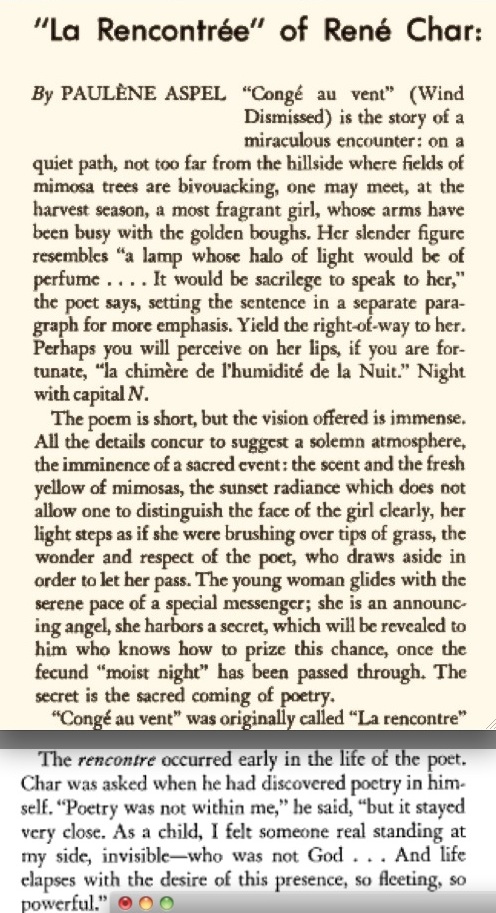
Three translations of poems by the enigmatic French poet René Char, much loved in France not only for his writing but also for his bravery in the French Resistance. The originals may be found following the title links. The painting right is "Mimosa" by the Italian, Nicola Simbari.

Parting Of The Wind

Camped out on the village hillsides are orchards of mimosa. During the gathering season, it may happen that far from this place you have an extremely fragrant meeting with a girl whose arms have been busy through the day in its fragile branches. Like a lamp whose bright halo is perfume, she wends her way, her back to the setting sun.

To speak to her would be sacrilege.

Sandal crushing the grass, let her pass on the footpath. You may chance to make out the glimmer on her lips of Night's elixir.

To —

You have been my love for so many years, 

My giddiness before so much waiting, 

Which nothing can age or cool; 

Even that which awaited our death, 

Or slowly learned how to fight us, 

Even that which is foreign to us, 

Both my eclipses and my returns. 


Closed like a box-wood shutter,
Compact and extreme,

Chance is our mountain-range, 

Our supercharged splendour.


I say chance, oh my finely wrought love; 

Either of us can receive 

The mysterious part of the other 

Without spilling its secret;

And the pain that comes from elsewhere 

Finds its shedding at last
In the flesh of our unity, 

Finds its solar orbit at last 

At the centre of our dark cloud
Which it severs and renews. 


I say chance, just as I feel it. 

You have raised up the summit 

Which my waiting will have to clear 

When tomorrow disappears.


Allegiance


In the streets of the town there is my love. It matters not where (s)he goes in the divided time. It is no more my love, anyone may speak to it. It remembers no longer; who exactly loved it?

It seeks a match in eyes of longing. The space it traverses is my faithfulness. It draws hope and lightly discards it, prevailing without taking part.

I live at its heart like a happy wretch. Unknown to it, my solitude is its treasure. My freedom burrows deep in the great meridian where it inscribes itself in flight.

In the streets of the town there is my love. It matters not where (s)he goes in the divided time. It is no more my love, anyone may speak to it. It remembers no longer; who exactly loved it and lights it from afar so that (s)he does not fall?

Sunday, 26 June 2011

The Waking (Marceline Desbordes-Valmore)

This is a reading of a new better translation of "Le Réveil" by Marceline Desbordes-Valmore (1786-1859). My old translation of this poem among others by her can be found in my previous post. There is precious little by her in translation either published or online for reasons explained there.

The music is Rachmaninov playing the end of Chopin's Nocturne Op. 9 No. 2 in E Flat Major.


The Waking


Upon this bed of reeds, could I go back to sleep?
I sense the fragrant air surrounding your body;
Your mouth, it is a flower whose perfume devours deep;
Come closer, oh my treasure!, engulf only me.
Awake to my melody!

But this breath of love, this kiss which I desire so,
On your lips I still dare not relish. I wait by.
With your heart’s consent, I would rise and heaven know;
Yet your sleep goes on, and this waiting makes me die:
I dare not relish what is nigh.

Under banana trees, we’d find a shady place.
The birds will sing at the sight of our lovers’ play.
The sun is jealous; in a cloud it hides its face,
It is in your eyes only that I seek the day:
Come light my love! I will stay.

No, no you sleep no more, you share my violet flame;
Your kisses are the nectar whose pollen makes bloom.
Your heart sighs; do you know my spirit feels the same?
Here take it from my mouth; it would dispel your gloom.
Hide me under your perfume!

Friday, 27 May 2011

Romances of Marceline Desbordes-Valmore

One of the most celebrated poets of 19th century French literature, an inspiration to Baudelaire and the whole symbolist movement in poetry, I would like to share my translations of some of the romantic poetry of Marceline Desbordes-Valmore: actress, poet, writer and great lady of letters, born just before the French Revolution. Only a handful of her poems seem to have been translated and published before in English, and only the first of the following as far as I can tell (see here for a lovely alternative translation, blog and photos of the poet), but that is sure to change in the coming years because the omission is so glaring. Having said that, it is understandable that they haven't been translated: her poems are often songs and indeed many were written set to music, so it isn't easy to capture their spirit and the playful language and rhyming. We can but do our best!

These were all written in the early 1800s. If you click on the titles, they link to the original French. I'd love to hear which ones you like, suggested improvements, corrections etc.


Separated Hearts

Don’t write. I’m sad and pensive, burning up my fire.
Bright summers without you are like a darkened room.
My arms clasped tight again, but not with their desire.
Beating at my heart is like beating at a tomb.
          Do not write!

Don’t write. Let us learn only to die to our flame.
Ask but God… ask but yourself, if I loved you!
Plunged into your absence, to know you feel the same
Is to hear of heaven, yet never climb there too.
          Do not write!

Don’t write. I fear your presence, lest my memory sink
So long she kept your voice, so often she recalls.
Don’t take me to the fountainhead where I can’t drink
The living portrait painted by a lover’s scrawls.
          Do not write!

Don’t write those sweet words which I dare no longer read
I feel your voice smothering them over my heart
And burnished across your smile, engulfing my need.
It seems that every kiss would stamp them on my heart.
          Do not write!


Confession Allowed

Come, my dear Olivier, I have three words to say to you
My mother has allowed it, she said they’d bring you joy.
Well, I dare no longer, but tell me, can you read?
My mother has allowed it, look into my eyes.

Here you see my downcast eyes. God! how I’m confused!
My cheeks have gone red. Can you see, it’s because I’m shy.
My mother has allowed it; you will be excused;
While I’m blushing, put your hand upon my heart.

How your air of worry torments and touches me!
These three words are so delicate! my heart says them so well!
You do not understand? take them then on my mouth;
I’ll close my eyes, take, but don’t talk to me about them.


First Love

Do you remember that young friend
With tender eyes, her expression wise and sweet?
Almost, alas! at the spring of her life,
Her heart feeling that it was made for you.

About to make a confession, about to make an empty promise,
Still so young, one knows them not.
Her soul pure and drunk with passion
Delivering itself without shame or struggle.

She lost her darling idol.
Happiness so sweet lasted but a day!
She is no more at the spring of her life.
She is already in love for the first time.


The Waking    ...a better rhyming translation in my next post!

On this bed of reeds, can I fall asleep again?
I feel the fragrant air surrounding your body.
Your mouth is a flower whose perfume devours:
Come closer, oh my treasure! and burn only me.
          Wake up! Wake yourself up!

But this breath of love, this kiss that I long for
On your lips, I still dare not relish it
With your heart’s consent, my life would double
Your sleep goes on, because of you I’m dying.
          I dare not relish it.

Come under the banana trees, we shall find some shade.
The birds will sing at the sight of our lovers’ play
The sun is jealous, it hides itself behind a cloud
And it is in your eyes only that I seek the day.
          Come set alight my love.

No, no you sleep no more, you share my flame
Your kisses are the honey that produces our blossom
Your heart lets out a sigh; will you come look for my spirit?
Here it is on my mouth; it would dry out your tears.
          Hide me under blossom.


To Poetry

O sweet Poetry!
Covered in flowers and lace
The sad dream
That makes tears run down my face;
My tender soul
Hurts still with its deceit.
I want to wait no more
For my amorous pleasures.

Give to the lines of my lyre
A good-natured colour,
Your grace to my madness,
Your charm to my heartache.
Would that the dark cloud
That cloaks my destiny
Flee like a shadow
At your divine sign.

Be ever attentive
To my mournful songs;
With a fearful modesty
Sheathe my confessions.
Hide that burning Error
That threatens my happiness:
But, O God! how slow she is
To leave my heart.

Tuesday, 14 September 2010

Certified Copy (Copie Conforme; France, 2010)


Rating:★★★★
Category:Movies
Genre: Other
If this film had been directed by Eric Rohmer, I would be bowled over in admiration, but just because it's by an Iranian director whom I’d never heard of, I’m less impressed. It turns out to be ignorance on my part, for Kiarostami is a well known and highly respected master of his art. To what extent is our appraisal of a work affected by its source?

The main character is an English author who’s just written a book called “Certified Copy” which he is promoting in Italy where its idea was born. The book sets out to prove the contentious claim that an authentic copy is of just as great a value as the original work of art. For art is a subjective personal experience, and the copy would give just as great a pleasure as the original, so long as the viewer looks up in awe as if it were original.

So there’s an admiration for the one who can look on the world with simple satisfaction. For example, what if a man stranded on a desert island came upon a bronze lamp and a genie appeared granting him three wishes? What would he ask for? Coincidentally, I’d asked exactly this question on Yahoo Answers just a couple of days previously! His first wish is for a self-replenishing cup of coke. He tests it out, taking a long cool drink, and indeed it replenishes. “Hurry up!” says the genie, “What is your second wish?” Delighted, the man orders two more!

This movie has been described as a more mature version of Before Sunrise and Before Sunset. It simply follows the two main protagonists, the English author and his French admirer, played by Juliette Binoche, as they seemingly aimlessly wander about a village in rural Tuscany, talking to each other in a mixture of languages, mainly English. It’s a talky movie, the kind I like, and that most people find very boring, though there is rather a Pirandello-twist of the genre of which it is a copy.

Themes of uniqueness, identity, memory and disconnectedness pervade. But on the other side is a dream of harmony, of union and of love that never changes. “For man, life is his work.” says the barmaid sweepingly, “For woman, life is for living in all its aspects in the knowledge that she is loved.” How then to bridge the separation? Isn’t love more than just knowledge? More than proofs, more than communications, more even than simple heartfelt gestures like a hand upon the shoulder... “If only we could be more understanding of each other’s weaknesses,” the writer muses as he sits alone, head bowed, but the faultline lies much deeper than understanding.

Maybe the answer lies in art…and imagination.

Sunday, 18 April 2010

Olivia Ruiz - La Petite Fable


Lyrics in French & approximate translation below... does it make any sense? Only a little, but I love it.

De la belle et la bête je suis les deux
Mon antre est une vaste comédie
Je suis seule malgré l'ombre de vos yeux
Le silence attire ma folie
Cendrillon j'ai rayé ta citrouille
Avec l'aiguille de ton talon dodu
Comment être vraie quand on me souille?
Mon pied nacré a besoin d'être nu

J'ai donné mon corps au diable
Enfin j'ai sauvé mon âme
Je m'enfuis de la fable
Je ne ressens pas de blâmes
Le vilain meurt, reste le beau
C'est ma vie de château

J'ai fini par tout perdre et tout gagner
Ne me jugez pas, apprenez moi
Je suis entière, je suis hantée
Ne me regardez pas, vivez moi
Moi je suis la petite princesse, fière
Sans parures et sans couronnes
J'ai vu le serpent, la faiblesse
C'est toute nue que je me donne

J'ai donné mon corps au diable
Enfin j'ai sauvé mon âme
Je m'enfuis de la fable
Je ne ressens pas de blâmes
Le vilain meurt, reste le beau
C'est ma vie de château

Je me fou de ce que l'on raconte
Ma vie est là si cela vous chante
Je suis sortie, grandie de ce conte,
Moi je ris, je bondis et je chante.


A Little Fable
Of beauty and the beast, I am both.
I reside in a vast comedy,
Alone, but for the shade of your eyes,
And the silence brings out my folly.
Cinderella, I've done away with your pumpkin
With the spike of your buxom heel.
How to be true when I am maligned?
My mother-of-pearl foot needs to be bare.

I gave my body to the devil,
In the end, I saved my soul,
I am running away from the fable,
I do not feel to blame,
The villain dies, the handsome prince remains.
This is my life in a fairytale castle.

I finished by losing everything and winning everything.
Do not judge me, learn about me.
I am whole, I am haunted.
Do not look at me, live me.
I am the little princess, proud,
Without finery and without garlands.
I saw the serpent, the weakness,
And it is in nakedness that I give myself.

I gave my body to the devil,
In the end, I saved my soul,
I am running away from the fable,
I do not feel to blame,
The villain dies, the handsome prince remains.
This is my life in a fairytale castle.

I could not care for what they say.
My life is there if it enchants you.
I have left, grown out from this tale
And I laugh and I leap and I sing.


For some reason the lyrics remind me of 
'The Lord of the Dance', 
here played on the harp by Mary O'Hara.
 

Finally, a little joke from a man of fable, the legendary mathematician Paul Erdös:

Sunday, 20 September 2009

The Sadness of the Moon (Charles Baudelaire)

Tonight the moon is lost in langorous reverie
Like a girl nestled in a bed of cushions, a beauty,
Who as she falls asleep, a bright hand gently rests,
Whispering its melody upon the contours of her breasts.


Floating on the satin back of a billowing avalanche
She passes out long gasping breaths, entranced,
And her eyes traverse heavenly visions of white
That blossom like jasmine flowers in the night.


When from time to time in silent contemplation deep,
She lets fall upon this world a secret tear, sorrowful,
A pious and attentive poet, enemy of sleep,


In the cup of his hand captures this prize
That reflects like a fragment of opal, iridescent,
And hides it in his heart, far from the sun's eyes.


—Charles Baudelaire, translated by —okei

The original poem and several translations may be found at
http://fleursdumal.org/poem/174. 
I was inspired to do this by Patrick's more erudite translation http://dpatrickt.multiply.com/journal/item/326. 
The image, like "The Star" which I used for my previous entry Silent Haikus, is another tarot card, this time "The Moon". Both this and that one are paintings by Thalia Took. "The Moon" apparently represents the beauty of the dark and the world of dreams, visions and creativity.

Monday, 8 June 2009

Gall & Balavoine


Nothing to Lose
 

(Both)
They take us for lunatics,
What must they think of us
We don't care
We don't care at all
We don't care about being poor
We like each other even more
When we have nothing to lose
When we have nothing to lose.

(Balavoine)
If you leave with me
People will show you the finger

(Gall)
If I left with you
I would forget who I was

(Balavoine)
You would be beyond it all...
If I chained you to me
You would like your chains

(Gall)
I would hang to you
Like ivy to an oak.

(Both)
Far from the undergrounds of Naziland
We would find a no-man's land
Where we could live
Desperately free

They take us for lunatics,
What must they think of us
We don't care
We don't care at all
We don't care about being poor
We like each other even more
When we have nothing to lose
When we have nothing to lose.

(Balavoine)
If you leave with me
Even if you wanted to
You would never be able
To go back.

(Gall)
When you choose your life
You must live it to the limit
I would be with you
Against the whole world.

(Both)
Come with us and risk your lives
On the motorways of foolishness
So now you understand
How far one can go
When one has nothing to lose
When one has nothing to lose.

Friday, 13 February 2009

The First Evening (Arthur Rimbaud)

This is my version of "La Première Soirée" (1870), translated from French. Rimbaud was only 16 years old when he wrote it, and it comes with a juvenile alert...(beep)(beep)(beep), but it's that time of year so I hope you don't mind.

The First Evening

She was practically undressed
And large trees craftily pressed
Their leaves against her windows
Curious and close, so close.

Sat in my large chair, half-naked
She clasped her hands upon her lap
And on the floor, she twitched with pleasure
Her little feet, so dainty and fair.

The colour of wax, I watched
As a flicker of sunlight danced
Across her smile and to her breast
Like a fly upon a rosebud.

I kissed her slender ankles;
She made a laugh, gentle and sharp,
Little tumbles of brightness
Tinkling like a chandelier.

The small feet vanished under her nightie
"Will you stop it!" she scolded,
The first bold move permitted
By the laugh that merely feigned to scorn.

Helpless trembles under my lips,
I kissed her eyes so gently.
She threw her fine head back,
"Ah! my, that's nicer still!

Listen! I have some words for you."
I plunged now to her breast
And in a kiss that made her laugh
True laughter that said yes,

She was practically undressed
And large trees blatantly pressed
Their leaves against her windows
Curious and close, so close.

Friday, 12 December 2008

The Disconsolate One (Gérard de Nerval)

I am the Darkness, — the Widowed, — the Scream,
The prince of Aquitaine, his Tower abolished:
My only Star is dead, — and my celestial lute
Bears the black Sun of Melancholy.

In the night of the Tomb, you who consoled me,
Bring me back Posilippo and the Italian sea,
The flower that so pleased my aching heart
And the trellis where the Vine and the Rose entwine.

Am I Love or Phoebus? … Lusignon or Biron?
My forehead is still red with the kiss of the Queen,
I dreamt in the Grotto where the Siren swims …

And twice a victor I crossed the Achéron stream
Modulating by turns on the lyre of Orpheus
The sighs of the Saint and the cries of the Fairy.


___________________________
This is my version of Gerard de Nerval’s “El Desdichado” (1854), translated from the French. The original may be found here.

And I just found another excellent page with lots of explanation and interpretation here.

Searching Google books, I found another translation in the Penguin of Nerval’s selected works by Richard Sieburth. I hadn’t seen this, but his translation is incredibly similar to mine!

Also, a further commentary here… http://everything2.com/title/El+Desdichado