Directed & Performed by: Isolde Penwarden, Emma Riggs, Miranda Slade & Chris Born
(18th May, 2013)
Rating:
★★★★★
Category:
Plays
Genre:
Romance/Paranormal
We hear a girl singing. She enters, nudges the table, and begins to read, then moves towards the cabin window to admire the beautiful sunset. This is the setting for “The River”, performed at the Small Studio of Homerton College, up the stairs above the Porter’s Lodge. In a sense it was my first time here, though I had also watched the superbly performed “Pink”, earlier in the term in the main College Auditorium.
A man enters in trenchcoat and fishing gear, pacing up and down as he runs through a checklist. Everything is rehearsed, but not everything is in its place. He has a new girlfriend. And everything new is slightly different. She beckons him to join her at the window. He has seen it all before, and can even describe it in poetry. It is a moment shared which neither will forget. At least it might be, but he does not join her. He averts his gaze, trapped by his own memories. Beauty has become jaded with repetition. All that excites him is the reflected joy he can give in sharing his world with her for the first time.
The cabin provides an idyllic setting for romance, for candlelit evenings after days spent fishing, walking in the forests, or swimming in the mountain pool. But the blossoming of first love is haunted by objects and memories that shatter the fantasy. She has gone fishing before. He has had other girls up at his cabin. How many times? How many times has he made love and said, “I love you”? Where is the first, the girl in the red dress whose image bears no face? Does she even exist? Why do we put so much value in beginnings?
The lesson is one of water that reflects and reflects, and what memories it could recount! But water holds no ghosts of its past. The trout return from the sea each season, each year becoming more beautiful, until one day caught by a fisherman. But the trout above all longs for freedom. So it is with love that would struggle against the net of memories to return to the water. Love without freedom is tragic, haunted by an ever-repeating cycle of disappointment.
Jez Butterworth’s “The River” brilliantly explodes the childish way we value first memories, attributing to them a quality of virginal fantasy. Was this my first experience of Homerton’s fantastic theatre scene? Not quite, but for that it does not make the experience less. Because every play is different, like every love, like every sunset. I certainly hope it will not be my last.
Philosopher Will Buckingham plays classical guitar, accompanied by two poems of Federico García Lorca in translation and a selection of Bulgarian art. The video was taken at the Bulgarian Cultural Institute, 15th Feb. 2013. at a book reading of 'Descent of the Lyre'. More information here.
"Arbolé, Arbolé seco y verdé" literally means "Tree, tree dry and green" but it is almost impossible to translate capturing both the rhyming sound of it, and the opposition between "dry" and "green". So it is best left in Spanish.
http://www.youtube.com/watch?v=Pym3t1YZikA Arbolé, Arbolé... (original) Arbolé, Arbolé Seco y verdé. The girl with the beautiful face Is gathering olives The wind, prince of towers takes her by the waist. Four horsemen pass by on Andalusian ponies with suits of azure and green and long flowing robes. "Come to Cordoba, young dear" The girl does not hear. Three young bullfighters pass by, Slender about their waists with suits of orange and swords of ancient silver. "Come to Sevilla, young dear" The girl does not hear. When the evening draws on, In purple dusk diffusing, a young man passes by carrying roses and myrtles of moonlight. "Come to Granada, young dear" But the girl does not hear. The girl with the beautiful face still goes on gathering olives with the grey arm of the wind encircling her waist. Arbolé! Arbolé! Seco y verde. Captive (original) Through the indecisive branches went a maiden who was life. Through the indecisive branches. With a tiny mirror, she reflected the day which was aglow upon her clear forehead. Through the indecisive branches. Upon night's shadows, lost, she wandered, weeping dew, for time held captive. Through the indecisive branches.
Stained Glass designs mainly by William Morris & Edward Burne-Jones
(in order of appearance)
Moses, Samuel, David, Solomon
Adam, Enoch, Noah, Abraham
Four Cardinal (Human) Virtues: Temperance, Justice, Fortitude, Prudence & their opposites: anger, slander, timidity, stupidity
Three Theological Virtues: Hope, Faith & Charity, with corresponding vices underfoot
Seraphim, Cherubim, Thrones, Powers, Dominions across the first row. Principalities, virtues, archangels, angels, imago dei across the second.
St. Ursula, St. Dorothy, St. Radegund around whose convent now the chapel Jesus was built, St. Cecilia, St. Catherine across the first row. St. Jerome, St. Gregory, Bishop Alcock the founder, St. Ambrose, St. Augustine.
Bishop Alcock of Ely, founder of Jesus College
Angel playing violin
Angels playings cymbals & harp
Angels playing dulcimer & double-pipe
John, sibyls alongside
Luke, sibyls alongside
Mark, sibyls alongside
Matthew, sibyls alongside
Crest of Hugo de Balsham who founded the first Cambridge college (Peterhouse) in Bishop Alcock's chapel in Ely Cathedral
The baby Jesus, with mother Mary and shepherds adoring
The young Jesus confounding the scholars in the temple of Jerusalem
Inner chapel window, Agnus Dei (lamb of God) at the centre of a cinquefoil rose
Patience, Obedience & Docility
The original stained glass designs were destroyed by
Puritan fundamentalists under Cromwell during the English Reformation.
The new designs were done mainly by William Morris & Edward
Burne-Jones in the 19th century. Notice the duality, good often literally stepping over evil. Notice the female saints are positioned superior to the male. Perhaps this is because they were literally there first — Jesus Chapel was originally a convent of St. Radegund (6th century) before it was appropriated to be the centrepiece of Jesus College, founded by Bishop Alcock (16th century). We might conjecture that the ordering left to right is chronological, but interesting that the right-most (right sometimes considered dominant) of these windows reads out: Solomon, Wisdom, Love (in the sense of charitas, or agape in Paul's letter to the Corinthians). Love is indeed the highest theological virtue, Wisdom the highest cardinal (human virtue) and Solomon a symbol of wisdom. All very fitting for a place of learning!
Paintings by John William Waterhouse. Set to music by Jan A. P. Kaczmarek. Poem by Salvatore Quasimodo. Sung by April Armstrong. Video by Accabadora. http://www.youtube.com/watch?v=DAyfpmo5Q18
Salvatore Quasimodo (1901-1968) — Tu Chiami Una Vita(You Invoke a Life)
Fatica d'amore, tristezza, Labour of love, sadness, tu chiami una vita You invoke a life che dentro, profonda, ha nomi That within, deep inside, has names di cieli e giardini. Of skies and gardens. E fosse mia carne And were it my flesh che il dono di male trasforma. Which the gift of sorrow transforms.
Eyes not up nor down, focused on the heart. Each step could go right or left or walk into another universe. Each breath, each moment, awake! —okei
"Each step could go right or left or walk into another universe." Hille said: I like that. :) I think I am mostly doing the last these days, when synchronicity keeps bombarding you then no sort of fiction can surpass the strangeness of reality!
I really was doing walking meditation while using this poem (which I'd written 3 days earlier) as a contemplation technique, a philosophy of "expect the unexpected" and a sense of presence in every moment, when I turned the corner and was stopped in my tracks by this beautiful rainbow...and of course the desire to grasp it surfaced and I just had to take out my mobile to photograph it.
Karol said: How good is this.!... Thanks for the beautiful poem, the beautiful rainbow, and a very good technique.
Photo: Sunrise over Lake Louise, Banff National Park, Alberta by Kevin McNeal.
Directions:
When I am with you, we stay up all night. When you’re not here, I can’t go to sleep.
Praise God for these two insomnias! And the difference between them.
The minute I heard my first love story I started looking for you, not knowing how blind that was.
Lovers don’t finally meet somewhere. They’re in each other all along.
We are the mirror as well as the face in it. We are tasting the taste this minute of eternity. We are pain and what cures pain, both. We are the sweet cold water and the jar that pours.
I want to hold you close like a lute, so we can cry out with loving.
You would rather throw stones at a mirror? I am your mirror, and here are the stones. Check out my beautiful new website here: http://karmice.tumblr.com
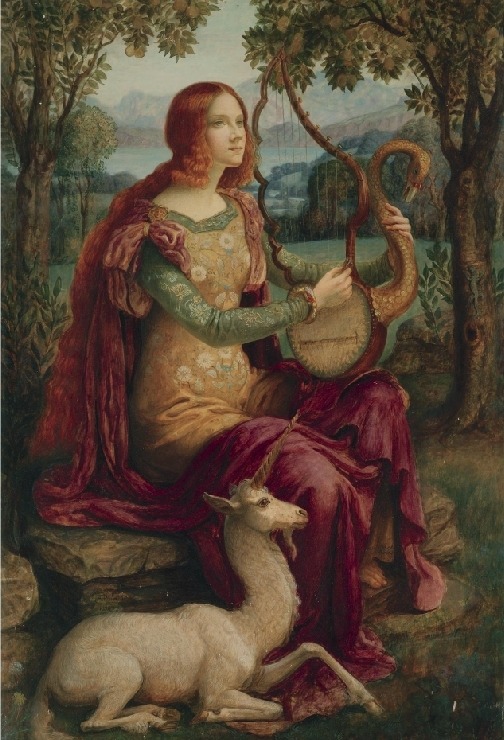
As if in dreams, I held your hand And followed you To wonderland, Back to the spring In mountains grand Where sages taught And emperors planned And artists wrought Their signs in sand. Your love touched me With words unplanned And now I ache My heart expand To fill the space Between us spanned, Inspired by breath The bodhi fanned To wake from dreams And understand. —okei This poem went through so many revisions. Thanks to Karol & Arjuna for bearing with me through them all, and giving generous feedback. I only hope this version is at least as good as the previous ones. Painting: “La Dame A La Licorne” by Armand Point
Psyche represents the human spirit or soul, and in mythology she was represented as a princess so beautiful that people adored her instead of Venus. To put an end to this sacrilege, Venus sent her son Cupid to make Psyche fall in love with the ugliest creature he could find. but when Cupid saw her he fell in love and forgot his mother's command. They became lovers, though Cupid forbade Psyche ever to look upon him. When at last she did, he fled in fear of what Venus would do to him in revenge. Psyche roamed the earth in search of her lover, facing obstacles thrown in her way by Venus to prove that she was worthy of her son. One of these tasks involved a golden box which she was forbidden from opening. When she did open it, she fell into a deep sleep of death. Eventually, however, Jupiter agreed that the lovers could be united for eternity. The couple's daughter was named Voluptas ("pleasure"). In Greek mythology, Venus is represented by Aphrodite, Cupid by Eros and Jupiter by Zeus. Source: Classical Mythology: the Ancient Myths and Legends of Greece and Rome.
I don't see an immediate connection between the poem of Rumi and the myth of Psyche, but perhaps one will dawn on me. They are both concerned with beauty. Perhaps another myth is relevant, the opening of Pandora's Box. Is the rending of the veils a point of both crisis and revelation, when we see beneath the many forms of beauty to the thing itself? It is a quest... of curiosity...
Additional thoughts on the connection... maybe first to seek beauty as St John of the Cross says, for the desires
of the heart which come in different forms are idols for this one
desire, to know beauty. As Rumi says, not to mistake the idol or box,
for the grace which moves within it from one form to another.
Now
Venus=Aphrodite represents beauty and she's upset that people are
loving Psyche, or things of the mind, instead of the real goddess...
herself! So she sends Eros to make the phantasm of the mind attracted to
something ugly. Instead of which the mind falls in love with
Cupid=Eros, it falls in love with love itself. The mind becomes hooked
on love, but estranged from beauty's source, Venus herself. The
forbidden box is supposed to have contained beauty from the underworld
for Venus. But Psyche was tempted to open it to take some herself. But
the box is empty. Beauty is not really in the box. The box is merely
graced with its reflection. But it's nice she's forgiven her error.
The
child of the mind and desire, Psyche and Eros, is pleasure. That's nice
too! As opposed to suffering in the Buddhist conception. Though they
are no doubt two sides of the same coin.
I did not have to ask my heart what it wanted because of all the desires that I have ever known, just one did I cling to, for it was the essence of all desire: to know beauty. —St. John of the Cross
Do you know the land of lemon groves and pines? Where in leafy shade, the orange golden shines. A soft sea breeze descends from an azure sky, The myrtle standing calm and the laurel high. There! There! Would I with you, oh my dearest!, like to roam.
In the masterworks I see How their magic works on me Through their beauteous harmony. Gazing at what I have wrought, I see what I really sought — How much still to do I ought!
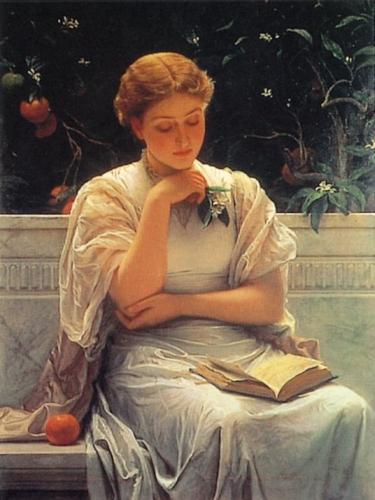
Painting: Charles E Perugini “Girl Reading”, also known as ”In the Orangerie”.
This is the first of the shamanic "Nine Songs", in Chinese Jiu Ge (九歌), supposed to have been collected by Qu Yuan in the 3rd century BC as part of his anthology Chu ci, or songs of Chu, often known as "Songs of the South". This is as a very late celebration of dragon festival day which is said to be in honour of this poet. The songs almost all express a love between the shaman and the god/goddess to whom the song is addressed, all except the first, addressed to the supreme spirit called "The Lord of the East". Here it is in translation alongside a beautiful video of Bei Bei playing "Under the White Wind" on the gu zheng (or zither). For more zither-playing by Bei Bei, see: http://www.youtube.com/user/BeiBeizheng
Directions:
The Lord of the East
On this auspicious day, favourable and sacred, Let us turn east and pray that we may please the Lord. I hold forth for Him my long sword by its jade guard. Clothes adorned with jade pendants make a tinkling sound. Gifts are laid upon the jewelled mat with its jade weights. I sprinkle the rich and fragrant flower-offerings, Served with orchids, tender meat wrapped with scented grass. I set out the cassia-wine and peppered drink. Now the sticks are raised, the drums are struck, To beats distant and slow, the chanters gently sing. Then the reed organ and zither loud reply. Finally come priestesses dancing in their splendid robes And all the hall is filled with the sweetest fragrance. The five sounds mingle in mellifluous harmony. The Lord is well pleased, his heart at rest.
Beauty brings out life's best! With prayerful breath she blows An ancient force impressed, A light which gently grows Upon my heart undressed A muse whom goddess froze Now wakes each moment blessed Transforming me in throes Of ecstasy and rest. I skate over rainbows And suck at heaven's breast And dare what no-one knows Relishing every test On Love's eternal quest.
Contemplations on Beauty in haiku form, accompanied by "In Cerca di Te" (Looking for You) with subtitled lyric translation into English, and illustrated with artworks listed in the credits.
Some say: Quarantine Beauty From's sin's opportunities Or regret love lost.
I say: Love springs from Goodness Or else it's a fool's desire And a miser's fear.
~_*_~ Days and nights I spend Trying to please a fickle friend Futile in the end.
Beauty's the promise To partake in heaven's fruit And share it with you.
What humbugs we are Who claim to live for beauty, But wake not for dawn. [Logan Pearsall Smith]
Beauty can't be hid, But the soul that spies her must Sometimes walk alone. [Johann Wolfgang von Goethe]
How lovely each part! Isn't it astonishing How she moves my heart.
Directions:
"In Cerca di Te" (Looking for you) - perhaps best known for its opening words - "Sola me ne vo per la città" - is a beautiful song written by Eros Sciorilli dating back to 1945. Here it is revived in an electroswing version in 2011, rearranged and with a voice cameo by Peter Cincotti, performed by singer Simona Molinari. The song tells about the search for a lost love, but it also represents the feelings of existential loss that struck many Italians waking up to their broken country in the aftermath of the Second World War. In Cerca di Te (Looking for You)
Sola me ne vo per la città passo tra la folla che non sa che non vede il mio dolore cercando te, sognando te, che più non ho.
Ogni viso guardo e non sei tu ogni voce ascolto non sei tu Dove sei perduto amore? Ti rivedrò, ti troverò, ti seguirò.
Io cerco invano di dimenticar il primo amore non si può scordar è scritto un nome, un nome solo in fondo al cuor t'ho conosciuto ed ora so che sei l'amor, il vero amor, il grande amor. Lyric Translation: Looking for You
Through these city's streets I walk alone Slipping through the bustling crowds unknown None can see my aching pain inside Searching, longing you were by my side. Every face I look, but it's not you Every voice I listen, it's not you Where are you, the love I knew? If only I could catch a glimpse of you, I will find you and I will follow I'll seek in vain this pain to swallow. My first love, how could I forget That name is written, engraved and set At the bottom of my beating heart When we touched, I knew that it was love My one true love, forever my great love.
Without haikus or voiceover, the original song from 1945:
There is only one situation I can think of in which men and women surpass themselves in the effort to read better than they usually do, that is when they are in love. They read for all they are worth, they read every word three ways, they read between the lines and in the margins, they read the whole in terms of the parts, and the parts in terms of the whole, they grow sensitive to context and ambiguity, to insinuation and implication, they perceive the colour of words, the odour of phrases, and the weight of sentences. They may even take the punctuation into account. Then, if never before or after, they read.
[Mortimer Adler (1940), How to Read a Book]
With the proliferation of information, we have shorter attention spans than ever. There's a paradox in that knowledge is wider than ever, and yet the discourse upon that breadth of knowledge is almost non-existent. Except for dedicated professionalism in specialized fields, or perhaps for love in Adler's romantic depiction, we are not prepared to work at cultivating our sense of appreciation. We either get it or we don't. With beauty so freely available, why work for it? And ah, what beauty. Let us at least remain sensitive to it.
Credits: The painting is by Vladimir Volego, and the video by Rossica59. I didn't know the origins of the music when I first posted this, and was a little embarrassed to find out, mainly because it was unknowing. ;)
Credits: Audrey Hepburn in Roman Holiday (1953) to the tune of Meglio Stasera.
Finally, an amazing sync of Nouvelle Vague's "Dance with Me" with Godard's 1964 film "Bande à Part" (Band of Outsiders), which I'm now dying to see... has unfortunately been taken down from YouTube, so instead I share with you this:
mysticmaze wrote on Feb 21 What an interesting quote from Adler! What is it do you think that triggers this love of a woman, Okei - in the general sense like Dante's Beatrice... I've always assumed it is the missing feminine archetype within...
jamintoo wrote on Feb 21 Had you heard of him? I was just starting to read his book yesterday from which I took that quote. I'm not familiar with Dante. About your question, I'm not sure, something to do with the feminine archetype within must influence our relationship with beauty without; is it missing? There are so many wonderful films which are essentially the director's homage to the grace and beauty of the lead actress. The beauty holds the film together, because it creates an interest, a curiosity for a story which perhaps is not really interesting, not really important either. Is there an element of voyeurism? I'm thinking Liv Tyler in Stealing Beauty, any film with Isabelle Adjani, or Emanuelle Béart, or... even Barbarella. I don't think it's a beauty than inspires desire necessarily (in the way that adverts and music videos and tabloid trash try to do). It is almost the opposite in some ways. It is more an aspect to beauty of an engaging presence. It probably does mirror some inner archetype in some way which is why we find it so engaging – why we don't need to "work" at appreciating it... but we do need to be sensitive to it! The video above might seem so slow and boring, the first time I came across it on a youtube recommendation I hardy paid it any notice, our attention spans for such things are so short because time is short and the amount of stuff online is so vast, but when I stopped to listen, it really is such a beautiful work of art, reminiscent of the film-homages to beauty that I was referring to earlier. I guess the last such film I saw was the teenage Sophie Marceau in "La Boum", where she acted so well the part of a sulky self-obsessed teenager, and all the actors were great, but she really made that film. Let's put that in reverse, and say, I really didn't like the film American Beauty despite popular acclaim because the lead actor was so hard to empathize and engage with. Since the story is told from his point of view, and the audience can't possibly like anything about him, I found it difficult viewing. Even if the lead actor/actress is a rogue, there must be something about him or her that charms us... or do you have a counterexample to that?
wistfuleden wrote on Feb 21 Nice post Okei. I can understand your reverence for some of those films. Even as a woman I can be enchanted by another woman's beauty. Whether it's her face, or the way she moves, etc. I can't stand films that objectify women, but I don't see the types of films you are mentioning as doing that. Watching Cat on a Hot Tin Roof with young Paul Newman and Elizabeth Taylor really is satisfying in that way. I'm surprised you didn't like Kevin Spacey's character in American Beauty, I thought he was likeable, I could relate to it.
mysticmaze wrote on Feb 22 This is interesting reading... trying to appreciate beauty from your pov and sensibilities, Okei. This stretches me because it is so foreign.... like listening to another language that my brain can't translate. That's why I asked about the archetypal aspect. Catherine is clearly able to see what you see. The uniqueness of each human perspective must surely be infinite. I'm trying to remember my response to American Beauty and can't... I'll have to watch it again. But, I don't have a counterexample.... I don't seem to have that gene for being charmed by an actor. It is the story and the meaning it communicates that registers the strongest... if the actor is good "I buy into the performance," and am carried along without any appreciation of them personally... their presence or looks or whatever. I'm absorbed into the drama to the point that I rarely remember the story narrative. It takes a second viewing to register.
jamintoo wrote on Feb 22 I'm not sure if we really do have such different perspectives? I don't notice the acting either so long as it's reasonably good, I'm carried along by the story like you say Nancy. But there are some films where the story revolves around character, and so we identify with the character to some extent. As Catherine said, it could be either gender. I don't think I've seen Cat on a Hot Tin Roof, but maybe I just caught bits of it once. Now in these homages to beauty, the director is like the guardian angel of the lead actress slightly in love with and always watching over her. The acting must be excellent, because the interest is not so much in the story as in the impact on our character, who by projection might well be a light shining on our own female archetype? She is angelic, but perhaps fragile, subject to dark forces, often fighting for freedom...or love. She might even die a tragic death. Without realizing whilst we're watching of course, the director is projecting love for her onto us. We identify both with her and with those who love her, so in effect we are perhaps loving ourselves? I'm just speculating here, but in any case the experience of beauty is satisfying as opposed to frustrating... Does this make any sense? Another great example is Charade with Audrey Hepburn. The Cary Grant character keeps changing identity. Is there a psychological interpretation? Like he could be us. :) The story is projected by the actor, is projected by the director in filming it, is projected onto us by our watching it, Freud would definitely have something to say about this...the incapacity of the artist spirit to love the beauty for real, or something, hence endless projection. I'm not sure how I'd respond to that, lol. Maybe it's a different kind of love though? And it identifies ourselves with the object of love in some way, not wholly outside of it?
I just discovered that the music was a soundtrack to a 1974 movie called Emmanuelle which was the beginning of a softcore series in France. This is not the kind of thing I meant at all! Feeling naive and embarrassed now, lol. All the movies and actresses I mentioned above are top quality in my view. When I said the story didn't matter, I didn't mean it like that. Rather, the story doesn't need to have substantiality. It can be pure style. I love all the movies I've seen by Eric Rohmer for example. I liked least his most famous, Claire's Knee. Nothing much happens but conversation, and the mundane is made beautiful. Beauty might involve nudity, but absolutely not in a sensually frustrating objectification. There I would agree with Freud.
mysticmaze wrote on Feb 22 "When I said the story didn't matter, I didn't mean it like that. Rather, the story doesn't need to have substantiality. It can be pure style." You're not naive, but rather eloquent, Okei! But, these two sentences above express the difference between our perspectives... I can appreciate style - for the artistry, but films without substance actually register as viscerally "painful." But, this is not the case in purely visual art, to which my reaction is the opposite. I recognized the music and thought that it was purposeful to the point you were making, but maybe it was only "Freudian???!" lol Music sticks with me and it was played a lot back then. Using music as an example of my difficulty with style... Mozart was a major part of my education and my music history professor was obsessed with Don Giovanni so I received huge doses. The content/narrative was very compelling to me, BUT the style of music was painful in a way I still can't describe. There is very little Mozart that I can bear to hear. However, there was one piece that I couldn't get enough of... the Lacrimosa from his final Requiem. But, of course I discovered that he didn't write it... he died and only left a sketch that someone else finished. :-) Here's a version:
As an example of style vs. substance/content
jamintoo wrote on Feb 22 I'll be back once I have audio. I've always found Mozart off-putting for a different reason, that he's just too perfect! Something he might have grown out of if he'd lived longer. Now, what was the point I was making, I've almost forgotten now, lol. Ah, reading and short attention spans, lol...
mysticmaze wrote on Feb 22 Yes, to his perfection, but the style inhibited the depth - to my ears. It is interesting that he received his "downloads" from the All, in totality and scored them without corrections.... amazing gift!
wistfuleden wrote on Feb 22, edited on Feb 22 Lacrimosa is one of the few pieces from Mozart I do like. I love it, the fact that it's a requiem probably doesn't hurt. He only wrote the first 8 bars (or something like that) and then he died and another guy finished it. But those bars clearly set it up. It's achingly beautiful. Haha, you've already said about someone else finishing it Nancy. Note to self: Read comments BEFORE commenting. ;) Lol, I just jumped right in there!
mysticmaze wrote on Feb 22 Interesting that we have the same response to it! :-))))
jamintoo wrote on Feb 22, edited on Feb 22 Ah, this! Apparently, this is in the Tree of Life, and the same version of it as I've heard before... by the Polish Zbigniew Preisner who did most of the soundtracks for Kieslowski's films, and composed this version when Kieslowski died. http://www.youtube.com/watch?v=1MOkUwbAdEU I love Preisner's music... from La Double Vie de Veronique http://www.youtube.com/watch?v=8-SX1TN2N0E I will be back to ponder and respond to the rest of the comment.
mysticmaze wrote on Feb 22 The Preisner Lacrimosa is STUNNING. Here is the translation from the Latin.
Lacrimosa dies illa Qua resurget ex favilla Judicandus homo reus. Huic ergo parce, Deus: Pie Jesu Domine, Dona eis requiem. Amen. [edit] English translation Mournful that day. When from the ashes shall rise a guilty man to be judged. Lord, have mercy on him. Gentle Lord Jesus, grant them eternal rest. Amen.
Interesting that the Lacrimosa is being discussed on Ash Wednesday!
wistfuleden wrote on Feb 22 "Yes, to his perfection, but the style inhibited the depth - to my ears. It is interesting that he received his "downloads" from the All, in totality and scored them without corrections.... amazing gift!" His stuff just came to him eh? Yes, that's cool. He's too tinkly for me though, usually. Like the king said in Amadeus "too many notes" lol.
Excellent! I waited and watched all the credits and wrote down all the music in TOL because what he used was incredible. Thanks for those videos!
Yes, love the translation. So goth.
Wow that second video was amazing! New to me, thanks!
jamintoo wrote on Feb 23, edited on Feb 23 So cool, Catherine and Nancy that you should have had identical responses to Mozart (even with your exception for Lacrimosa!). I think once we're enlightened, then because Mozart is music from the heavens, it will become heavenly to our ears. Until then we want beauty and energy, not heaven. We want Beethoven! :^) I know Catherine does. ;^) Ash Wednesday, beginning of Lent, "remember that thou art dust, and to dust thou shallt return". And Lacrimosa is looking forward to the day of resurrection? I didn't realize that, but now it's reminding me of the Double Life of Veronique (second link I posted) where the girl dies and is re-born in her double. Let me look up the lyrics of that! :) The lyrics of Van den Budenmayer's Concerto in e minor They are contained in the French version of the "Double Life of Veronique" CD. Dante II'eme chant -
Verso il cielo O voi che siete in piccioletta barca, desiderosi d'ascoltar, sguiti dietro al mio legno che cantando varca,
Non vi mettete in pelago, che' forse, perdento me, rimarreste smarriti. L'acque ch'io prendo gia mai non si corse; Minerva spira e conducemi Appollo, e nove Muse mi dimostran l'Orse.
Giustizia mosse il mio alto fattore fecemi la divina podestate la somma sapienza e'l primo amore.
It's Dante! I really should read him sometime. As for what it means, I need to go hunting... :) It's Canto II of the Paradiso, and the verse after she passes out according to the lyrics above, Canto III of the Inferno though I don't actually recognize them being sung... Rough translation: All you who in your little boat Desiring to listen Have followed after my ship that sails onwards singing, Do not put out on the deep sea, For losing me, you might be lost. The waters that I take have never before been crossed. Minerva inspires and Apollo leads, And nine Muses point out to me the Bear constellations. (she faints, and in death re-born?) Justice inspired my high Maker: The divine power made me The utmost wisdom and the original love.
By the way, what's TOL? (Is it some way of writing notes - I don't know how to read music or play music myself... except with speakers, lol)
wistfuleden wrote on Feb 23 TOL=Tree of Life :)
While we're on to Dante, here is the opera piece that was composed by Patrick Cassidy for the movie Hannibal. The lyrics are based on his Vita Nuova.
jamintoo wrote on Feb 23 :) I'm so tired! I think I should stick with the sweet sleep overcoming me of the first line... off home and to bed! Ciao! And thanks to you and Nancy for enlightening conversations.
mysticmaze wrote on Feb 23, edited on Feb 23 Glorious music by Cassidy! Thanks, Catherine. I love the imagery - back and forth between Florence and Venice. Heaven to me would be wandering around those streets and canals for eternity... it would take at least that long to absorb all they have to offer... I enjoyed the book but hated the film - despite the scenery!
jamintoo wrote on Feb 24 Beautiful indeed, music and architecture! Never been to Italy, would love to go one day... soon.
More cheesy French music :) put together by another skilful video-maker on YouTube.
If there's any deep meaning to the lyrics, I'm missing it, but I wrote a translation in the comments at
Light up for me my last cigarette Write your number on my napkin Have you room under your umbrella Good morning, my name is Valerie Excuse me, my name is Valerie One, two, three, and you smile at me I'm walking on the roofs tonight And I make my choice that is to be with you I'm bored constantly despite the speed What will happen when I cross the line Just for a tiny little yes I betray drunkenness with delicacy Believe me, I don't like stress I'm walking on the roofs tonight And I make my choice that is to be with you Am I a princess without joy Who is forsaken for a little pleasure? Feet in the ocean I never had a plan For so long, you were the obvious one I'm walking on the roofs tonight And I make my choice that is to be with you
Back on the subject of reading, I heard about the Greeks studying three disciplines: grammar, rhetoric & logic, none of which are studied today, but which are essential in order to understand the art of reading, and not being taken in... (as so many are by the most base level of political discourse).