Showing posts with label freedom. Show all posts

Wednesday, 7 December 2016

What is Love? (Krishnamurti)

In January 1986, at the age of 91, Jiddu Krishnamurti gave his penultimate talk, at Madras in southeast India, near the place where he was born.

The full transcript may be found at the link: 
http://www.jkrishnamurti.org/krishnamurti-teachings/view-text.php?tid=1681&chid=1373
What follows is a summary of what he said.


What is Love?

You have to think, not just agree – doubt, question, enquire together. I am not here to guide, instruct or help. We've had that kind of help for generations and look where it's got us.

We are walking up a very long street together. It requires energy. To enquire very profoundly, we must also enquire, what is energy? Everything on earth requires energy. What is its origin? Abandon all that the ancient people have said; leave it at the roadside and let us walk on.

Is there an energy which is not contained within the field of knowledge, not put together by thought?

Thought gives great energy; to wake up and go to the office at nine o'clock every morning, earn money, plan for the future. Thought has planned this society which has divided this world into communist, socialist, democrat, republican, and the army, the navy, the air force. Without thought, we can't do anything. Thought is based on knowledge and knowledge on experience. Experience is stored as memory and this is the origin of our thought. But experience is always limited, always adding more. Therefore thought is limited.

Thought has created fear. Fear arises because we want security. Fear on its own is a tremendous energy. But fear destroys love; love cannot exist where there is fear, the two are totally divorced from each other.
So what is the origin of fear? To question all this is to be alive, to understand the nature of love. Time and thought are the central factors of fear. Time is both inward — I am this, I will be that — and outward. Time and thought are both movements. They are the principal factors of life. Is that all of life? Your consciousness if you examine it closely is made up of its content. Every human being on this earth goes through suffering, pain, wanting this, not wanting that. Your consciousness, which is what you are — not physically but psychologically, inwards — is the consciousness of mankind.

Have you ever enquired very closely into what is death? It must be an extraordinary thing to die. Everything is taken away from you: your attachments, your money, your children, your country, your superstitions, your gurus, your gods. I want to find out for myself, whilst living, what it means to die. You don't see the beauty of it, the greatness of it, the extraordinary strength of it — whilst living to be dying. You understand what that means? Each day is a new day. There is tremendous vitality and energy there because there is nothing you are afraid of. There is nothing that can hurt. All the things that man has put together have to be totally abandoned. So can you do it? Will you experiment with it? Not for just a day; every day. 

No, you can't do it. Your brains have been conditioned so heavily by your education, by your tradition, by your books, by your professors. It requires finding out what love is. Love and death go together. Death says, "be free, non-attached, you can carry nothing with you". And love says, love says… there is no word for it. Love can only exist when there is freedom. It does not come from your wife, your girlfriend, your boyfriend. But the feeling, the enormous strength — the vitality, the energy of complete freedom.

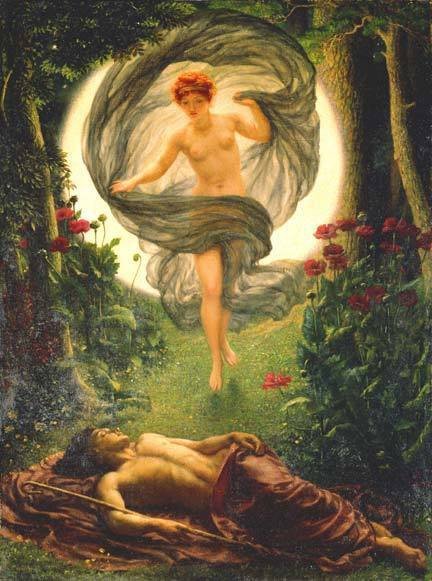
Painting: Clytie by Lord Frederic Leighton. Clytie was a nymph in Book IV of Ovid’s Metamorphoses who falls in love with the sun god Apollo.

Shared originally on Buddhist Travellers in 2011.

Wednesday, 25 December 2013

Like Water, Like Light — A Contemplation on Freedom

I'd like to share a lovely thought I had this Christmas morning. Merry Christmas all!


There is an economic idea, wonderful in theory, that the free movement of money and people and goods and ideas is in the best interests of everyone. But in practice human beings and the things they want are not like water. When we enter a cup, we do not "become the cup" as Bruce Lee wisely recommends us. We have culture, and home, and it's impossible to ask for freedom from others when we are not ourselves free. And even in cases where we would like to be free, we are discrete units and we have a natural resistance to movement and change. A good image to have is of a traffic jam. Even if the road ahead of the first car is empty, it takes a while until the last car can get going. How to adjust for this? Is it possible to "be like water" and so regain our freedom?

The solution to the traffic jam problem would be if cars could hold on to each other like carriages in a train. Paradoxically, it is through a lack of freedom that discrete units can best realise their freedom. The important thing is to be able to bind ourselves in the direction we wish to be going. The freedom to bind to a future intention actually gives freedom of movement instead of taking it away. Connections to family, friends and society as a whole makes us continuous beings. The traffic jam is a product of modernity and discreteness. But of course we are both.

It's fascinating to think that even at the smallest scale, light particles/waves are both discrete and continuous simultaneously. Perhaps when light is behaving like a wave in the twin-slit experiment, the interference pattern it creates is in some sense caused by interferences of intention? When the intention is observed, light behaves like a particle and the interference resolves itself one way or the other. If light is a symbol of absolute freedom, then what can we learn from it?


... One would imagine light to be forgetful of where it's been or where it's going. But there is a phenomenon called quantum entanglement which means two photons can be at opposite ends of a galaxy, but they still maintain the other within themselves.


A friend of mine posted today "a free spirit is someone who lives by their own wishes and is unconstrained by society". I would like to be a free spirit, but would define it differently (inspired by Nietzsche): "A free spirit is one who has the resilience of an ass, the courage of a lion, the innocence of a child, yet doesn't fight the world but flies in the tailwind of eternity."

Does a free spirit ever think they are free? I know that I'm not free, very far from it, but I have the aspiration nonetheless. In order to realise freedom, I think we need to acknowledge that we are not free, how in a limited sense we are the result of our whole life up to now, but also we are completely free in this moment to change a tiny bit, and bit by bit to become more free. To be like light, to be like water.

And that means to be willing to surrender to the universe, to let go of conflicting intentions within ourselves, to let those conflicts resolve themselves by themselves. And when we have clarity of intention and the way becomes clear, to bring the future into the present and hold firm to that intention to take us where we want to go. And wherever we go, like light, to remember our friends, even on the opposite side of the universe.


Photo: 'Waves in the Sunrise' (2009) by —okei

Wednesday, 29 May 2013

The River (Jez Butterworth)

Directed & Performed by: Isolde Penwarden, Emma Riggs, Miranda Slade & Chris Born 
(18th May, 2013)

Rating:★★★★
Category:Plays
Genre: Romance/Paranormal

We hear a girl singing. She enters, nudges the table, and begins to read, then moves towards the cabin window to admire the beautiful sunset. This is the setting for “The River”, performed at the Small Studio of Homerton College, up the stairs above the Porter’s Lodge. In a sense it was my first time here, though I had also watched the superbly performed “Pink”, earlier in the term in the main College Auditorium.

A man enters in trenchcoat and fishing gear, pacing up and down as he runs through a checklist. Everything is rehearsed, but not everything is in its place. He has a new girlfriend. And everything new is slightly different. She beckons him to join her at the window. He has seen it all before, and can even describe it in poetry. It is a moment shared which neither will forget. At least it might be, but he does not join her. He averts his gaze, trapped by his own memories. Beauty has become jaded with repetition. All that excites him is the reflected joy he can give in sharing his world with her for the first time.

The cabin provides an idyllic setting for romance, for candlelit evenings after days spent fishing, walking in the forests, or swimming in the mountain pool. But the blossoming of first love is haunted by objects and memories that shatter the fantasy. She has gone fishing before. He has had other girls up at his cabin. How many times? How many times has he made love and said, “I love you”? Where is the first, the girl in the red dress whose image bears no face? Does she even exist? Why do we put so much value in beginnings?

The lesson is one of water that reflects and reflects, and what memories it could recount! But water holds no ghosts of its past. The trout return from the sea each season, each year becoming more beautiful, until one day caught by a fisherman. But the trout above all longs for freedom. So it is with love that would struggle against the net of memories to return to the water. Love without freedom is tragic, haunted by an ever-repeating cycle of disappointment.

Jez Butterworth’s “The River” brilliantly explodes the childish way we value first memories, attributing to them a quality of virginal fantasy. Was this my first experience of Homerton’s fantastic theatre scene? Not quite, but for that it does not make the experience less. Because every play is different, like every love, like every sunset. I certainly hope it will not be my last.

Tuesday, 19 March 2013

Genealogy of Morality - Nietzsche

Rating:★★★★★
Category:Books
Genre: Literature & Fiction
Tagline:Beyond Good & Evil, not beyond good & bad!

Preface: Genealogy of the Genealogy

Nietzsche describes in his preface a personal genealogy of his project concerning morality’s history. The question of evil was the subject of his first philosophical essay — then, at the tender age of thirteen, he had attributed evil to God! But in order to tell of this and of the subsequent development of his ideas, he must rely on memory, on self-reflection, examining what had earlier occupied his thoughts, not on direct present experience. “We are unknown, we knowers, ourselves to ourselves”. Thus opens Nietzsche’s genealogy. A genealogy of morality presupposes a genealogy of truth, even of philosophers as “knowers” of truth, and perhaps also of oneself.

It is only over time, he says, that his thoughts have come to fruition, connected and interrelated into a unified philosophical enterprise, thanks to the development of both a new language and greater clarity within himself. He feels this unity more than he ever had in previous works such as “Human all Too Human”, both as fact and as duty in presentation. This sense of unity reinforces his confidence in what he wants to say, which ironically will be to ultimately deny unity to the goddess Philosophy that bedevils him (and society) with her objective ideals of Truth. If his fruits are not to our taste, “what matters that to the trees? What matters that to us, us the philosophers?” His are living subjective truths.

The question about the origin of evil is replaced by new questions: (1) how man came to invent such value-judgments as “good” and “evil”? (the historical conditions that led to their arising), and (2) whether these concepts possess intrinsic value in themselves to promote life, strength, fullness, courage, and human well-being? For what if, on the contrary, our idea of “good” were detrimental to humankind in the long-term? Nietzsche, skeptic but not nihilist, would like to see a revaluing of our values in terms of maximizing the long-term potentiality for human brilliance.

Paul Rée (1877) had suggested that our values derive from altruistic acts praised by others for their utility, and this reason for them being “good” is then forgotten, but Nietzsche disagrees that usefulness for the “other” could be forgotten since we would continuously be reminded of it. He rejects too what he regards as the more reasonable hypothesis of Herbert Spencer that “good” symbolizes unforgettable experiences of utility for the “other”.

For Nietzsche, the original (and truest) idea of “good” is a spontaneous overflowing of the noble self, who for itself defines this “good”. And yet Nietzsche also defines “good” as that which is worthy of being admired, and in this formulation he unwittingly approximates his rejected idea of “good” as rooted in the “other”. The “other” in this case would be the imagined admirer who admires only what is worthy of being admirable. Such a “worthy” observer would necessarily require a “good” imagination to imagine her, so Nietzsche’s “good” is after-all a most positive and self-reinforcing concept so far as it exists at all.

Nietzsche’s thesis is that the “morality of pity” and its culmination in the ascetic ideal of the philosopher and renunciant-priest are dangerous seductive temptations of society away from the original life-affirming self, confident in its own “goodness”, and a slide towards nihilism.

Nietzsche’s evidence that “good” was founded in the values of the noble races of antiquity is philological (from an analysis of Indo-European etymology) and historical (though his history is mostly imagined). Despite the inadequacy of Nietzsche’s history, his etymology is nevertheless convincing. The “simple” (“schlict”), once associated with “bad” (“schlect”), has over time come to mean the exact opposite: the simple man is the good man. Meanwhile, the aristocratic “good” which once meant the sincere, the clean, the successful, has taken on deadening moral overtones and become associated with the peaceful life. Nevertheless, it would be a genetic fallacy if we answered Nietzsche’s second question of whether our current conceptions were conducive to human flourishing on the basis of their original meanings and prejudices. What these changes reveal however is an inconsistency. This inconsistency forces us to doubt our inherited concepts, and to take his questions about morality seriously.

Not only does Nietzsche want to be read, but he wants to be ruminated upon, and the third essay in his book will be an example (based on an aphorism in “Thus Spake Zarathustra”) of what he imagines such a rumination should look like. He makes no small demand on his readers that they may “enjoy the halcyon element from which that work is born, in its sunny brilliance, its distance, its spaciousness, its certainty.” 


First Essay: Good & Evil

While Nietzsche admires the so-called “English psychologists” for being the first to dare examine the origins of our morals, he criticizes them for locating the “decisive element” of morality in passive principles: in man’s “forgetfulness”, “habit”, “stupidity”, in short on conditioning based on “error”. What a menagerie of “old frigid and tedious frogs hopping around men and inside men, as if they were as thoroughly at home there as they would be in a swamp” he quips.

According to Nietzsche, there is no antithesis between altruistic and egoistic to begin with because the first masters of language define “good” according to their own aristocratic values, and “bad” in contradistinction to it. Nor is there an antithesis between a subject and his or her actions, for there is no subject-predicate, no being behind doing — only doing, and so no sense of responsibility for being anything other than what one is: “good”. The actions of the master are “good” because it is master. This is master morality.

Meanwhile, other parts of the body-politic suffer. Unable to ease their suffering, they resent the master’s power. In a reversal, the master is seen as “evil”, and the weaker or slave-element in man defines itself as “good” (by this account then, “evil” comes first, the beginning of the gravest error, the creation of value based on resentment). This is the reactive slave morality that Nietzsche so abhors because he sees it as taming what was noble and active in man. The master in man is conditioned. Slave morality is based on prudence. It demands responsibility (the master, now separated from identification with the “good”, must take responsibility and make a choice to become “good”).

The master was foolish not to see it coming. But unlike the slave, he lacks cunning. Though cruel and violent at times, he knows no resentment except of the sort which he acts upon immediately. In contrast to seeing his enemy as “evil”, he reveres him as worthy of his distinction. It is only an active master-mentality that can go so far as to “love one’s enemy” as Jesus had preached (if such a thing is possible). Bearing no grudges, there is no question of forgiveness because all that is separated from action is forgotten. This is not a conditioned forgetfulness, but an active forgetting. In the same way, the sovereign individual is capable of an active remembering. The great will promises sparingly, conferring honour by its trust, knowing to its innermost depths that it is strong enough to fulfil its promise, “even in the teeth of disasters, even in the teeth of fate”. This is the true meaning of conscience, based on honour and supreme will.

The master is a sovereign individual. He is a symbol of the Apollonian overrun by the Dyonisian herd. As examples of this phenomenon, he cites the Reformation in reaction to the European Renaissance, and also the French Revolution. The latter, in a counter-reactive movement produced the terrible anachronism of “Napoleon, that synthesis of Monster and Superman” who represents “the incarnate problem of the aristocratic ideal in itself”, the ideal idealized. “May there not take place at some time or other a much more awful, much more carefully prepared flaring up of the old conflagration?” Nietzsche is uncertain whether he wishes for it or not. It is almost as if he has a bad premonition of being misunderstood by those who do not even know “what I exactly mean by that dangerous motto Beyond Good and Evil — at any rate that is not the same as beyond good and bad”.

In a way, weren’t the “English psychologists” right after all in locating our reactive sense of morality in our conditioning? And Nietzsche is right also to promote a more positive idea of conscience of the sovereign individual based on honour and supreme will. It is this good conscience which, in a reversal, has been undermined with resentment and unsatisfied revenge. In the third essay, we will see a second reversal whereby the resentment of slave morality is turned inward upon itself by the ascetic priest. The slave-element becomes itself “evil” and responsible for its own suffering. Nietzsche investigates this internalization of guilt, or so-called “bad conscience”, in his second essay, by which the priest gives meaning to suffering, for it is meaningless suffering which man cannot bear.

Second Essay: Bad Conscience

That supreme will to fulfil one’s promise — is it really a natural quality of the master, or is it burnt into the memory by pain? The history of man is replete with public and varied methods of torture and punishment that leave their scars in our collective unconscious. However, at least to begin with, Nietzsche claims that punishments were not based on guilt, but rather as the currency of exchange for some debt. In German, “Schuld” means guilt , while “Schulden” means debt. In English, we have a similar double-meaning of “ought” and “owe”.

Justice was not based on “right” and “wrong”, but on a coming-to-terms, by agreement where the parties were of equal strength, or compelling them to agree if they were not. Justice is not based on reactive feelings of resentment or revenge, but rather plays the role of a substitute-settlement softening the desire for revenge. It is a social exchange before it develops into the foundations of law.

Law restrains reactive feelings. It does not precede “right” and “wrong”, but rather founds them. The actor is separated from the action, held responsible for it, and to the extent it falls short, man as measurer of things inflicts a corresponding punishment.

The satisfaction in inflicting pain was measured against the duty unfulfilled. We balk at this today! How could inflicting pain be a satisfaction? But for the benefits of community life, Nietzsche believes that this was the price we had to pay, and we forget the ancient joy in cruelty, a joy we have repressed and turned inwards on ourselves. As the power of a community increases, so the need for punishment is mitigated. But “conversely, every weakening and jeopardising of the community revives the harshest forms of that law”.

Though revenge was not the original purpose of punishment, and law was conceived as an ordering power to be applied in exceptional conditions, everything which prevails anywhere “will always be put to new purposes by a force superior to itself”, in an overpowering that can extinguish any subsisting “meaning” it might have held. Indeed, the origin of a thing and its final utility are often utterly contrary to each other. There is no natural progression, only an appropriation by a greater will, with no ultimate arbiter, for this is so for the sovereign will itself. So law, in its own eventual overcoming by reactive values, is “conceived of as sovereign and universal”. In this form, it becomes antithetical to the power struggle itself, and thus “hostile to life”. Nietzsche approves of law at its inception where it regulated an exception in a struggle between a complex of powers, and was itself one such power. An example might be the law that insisted a break in fighting for lunch during the Battle of Hastings in 1066. It is the law that prohibits fighting altogether that Nietzsche finds oppressive.

Law also institutionalises punishment, which over the ages has been applied for very different reasons. The variation of reasons shows an incoherence in something whose meaning is normally taken for granted. This claim of incoherence is the essence of the genealogical approach to history which Foucault later applied more widely. The institution or habitual form of behaviour changes little over time, unlike the meaning which results from an imposition of will.

One meaning that punishment has never claimed to possess is the one we should most desire: a means to awaken intrinsic morality. On the contrary, it hardens and makes man cautious and cunning. People begin to obey the law not out of intrinsic morality but out of fear of punishment. Domesticated like animals, intrinsic morality or "good conscience" is like a muscle that grows weak through disuse. In the expectation of punishment, man represses his exuberant vivaciousness and turns his will to power and instinct for freedom against himself. The result is an internalized consciousness of guilt, what Nietzsche calls “bad conscience”.

This reflects a general principle for Nietzsche that psychological phenomena arise originally out of concrete social practices, and not the reverse. We are “guilty” because we are punished, not punished because we are “guilty”. This is not a form of philosophical materialism, just a claim that the psychological environment that led to the social practices was quite different from what these social practices themselves later brought about.

Bad conscience is the debt that can never be repaid. It turns against oneself, becomes active and seeks new and higher standards of customary morality. The purpose of these more and more demanding ideals is precisely that they are beyond reach, thus impossible to attain, perpetuating self-inflicted suffering. The devil is in the details! The result of this active bad conscience is a striving for self-improvement that creates much that is beautiful in the world, even the idea of beauty itself. If it is illness, it is so in the same way “as pregnancy is illness”.

Going back once again to the origins of this bad conscience, Nietzsche believes that the debt of obedience to society is transferred into a debt to ancestors and heroes who are revered as gods, the founders of society, ultimately becoming a debt to God, and thus a duty to ideals in themselves. The debt is too great to ever repay, and so no punishment can repay it. It is in this abject circumstance that Nietzsche conceives the Christian idea of Jesus, flesh of God, taking on man’s punishment while not assuaging his guilt, “the creditor playing scapegoat for his debtor, from love (can you believe it?), from love of his debtor!” Nietzsche contrasts this with the Greek gods who took on man’s guilt (which was “more noble”), whilst not lessening their punishment. The Greeks saw the vicissitudes of man as the result of foolishness (not sin), and how could aristocratic man fall prey to such folly? Why, “it must be that a god infatuated him”!

Nietzsche would like to see a reversal of religious conditioning based on fear and guilt, and a return to innocence. It is a different love that Nietzsche strives for, a love of free spirits “to whom conquest, adventure, danger, even pain, have become a need”, spirits of “great health”. It is the love that comes from letting ourselves go from the burden of bad conscience. “How conciliatory, how full of love does all the world show itself towards us so soon as we do as all the world does, and “let ourselves go” as all the world”. “In a stronger age than this rotting and introspective present” will come to us a redeemer of this great love, a redeemer of reality, “this Antichrist and Antinihilist — this conqueror of God and of Nothingness — he must one day come”. Nietzsche refers of course to his imagined prophet, Zarathustra, who might perhaps turn the very state of “bad conscience” against itself. But he catches himself in this hope that expresses nothing but his own bad conscience. The only proper response for him is silence.

Third Essay: The Ascetic Ideal

Nietzsche begins the third essay by describing the effects of the ascetic ideal: in artists “nothing or too much”, in women “the angelhood of a fat, pretty animal”, in the majority of mortals “an attempt to pose as “too good” for this world, a holy form of debauchery”, in priests an “engine of power”, in saints “a pretext for hibernation” and in philosophers “the conditions most favorable for advanced intellectualism”. 

In artists “nothing or too much” — what can he mean? Nietzsche felt that Richard Wagner’s paying homage to chastity, with his folk-hero Parsifal, was a betrayal because it was worshipping in old age what was in tragic antithesis to his own healthy sensuality of youth. The artist (like the philosopher) is only chaste by accident in so far as his energies are directed to higher pursuits, and so “there is no necessary antithesis between chastity and sensuality”. Even to the extent that there is conflict, this is something to celebrate as in Hafiz or Goethe, a further charm, a delicate balance that we are between animal and angel, something that allures one to life!

In any case, art should not be judged by the artist who is “after all merely the presupposition of his work, the womb, the soil, in certain cases the dung and manure on which and out of which it grows.” The question of origins is one for psychologists and vivisectors, but never for aesthetes and artists themselves. And so when it comes to art, ascetic ideals mean nothing because the art stands alone. As for the artists themselves, it means too much, a betrayal to nothingness.

There follow diatribes against both Kant and Schopenhauer, the latter whom he thinks unduly influenced Wagner into his volte face. Beauty is not without self-interest as Kant had insisted, nor a sublimation of libido as Schopenhauer had claimed. Nietzsche believes rather in Stendhal, whom he thinks, as an artist, knows the truth of these things better. Stendhal famously described the beautiful as une promesse de bonheur, “a promise of happiness”. Is Stendhal right?

Nietzsche believes Schopenhauer’s conception of beauty is confused not only by what is peculiar to Schopenhauer (perhaps for example his need for enemies in Hegel, woman, sensuality and the “will for existence” — passions of enmity which “kept him going”), but what is peculiar to him as a “youth of twenty-six”, implying his excess of sexual interest influenced his philosophical judgment. Schopenhauer’s sublimation of libido in beauty represents a certain insight to Nietzsche, the use of beauty as “escape from a torture”, and what is that if not self-interest?

The philosophical animal strives for ascetic ideals, and for Kantian disinterest, because the idyllic state they bring about results in an optimum of productivity for the intellectual life. It is hubris that philosophers prize ascetic ideals because they epitomize philosophical self-interest. Nietzsche makes a list of great unmarried philosophers, all the greatest philosophers he claims (apart from Socrates), and no doubt comforts himself to be among them. “The philosopher shuns three brilliant and noisy things — fame, princes and women”, and he does this out of an overriding maternal instinct for what is best in himself. “A married philosopher belongs to comedy”, he jeers. He is writing of course before either A. J. Ayer or Jean-Paul Sartre, both notorious womanizers. He means perhaps by all this that his own rejected proposal for Lou Salomé’s hand has been of untold benefit to philosophy.

So, unlike Kant, Nietzsche insists on the sensuality of the aesthetic state, possessing a “sweetness and fulness”, just as the idealism of adolescent youth is a form of sensuality, but it is sensuality transfigured and so not witnessed as sexual excitement.

The hubris of the philosopher would deny us the sensual pleasure. But how has it come to this? “All good things were once bad things”. Philosophy would have been “absolutely impossible in the world without the ascetic priest”, and ascetic ideals involve reversals in morality that the priest has helped bring about.

What is the real meaning of ascetic ideals? The ascetic ideal is the belief that in principle it is bad to exercise the will. It gives meaning to one’s own weakness and suffering as a consequence of activity being evil. In the long run, it starts a self-reinforcing debilitating cycle that increases suffering.

In the Christian setting, Nietzsche sees “innocent” therapies for suffering in prescribing work, the doing of good deeds, and finding joy in the joy of others, all these an expression of an infinitesimal communal will to power. Meanwhile, the “guilty” therapies for suffering are the ascetic practices which equate man’s suffering with sin: not only are we responsible for our suffering, but guilty for it. Nietzsche, of course, believes that there are no such things as moral phenomena, only moral interpretations of phenomena. Concepts are like coins whose images have been effaced to leave mere tokens, dominated by will, and he would deny any metaphysics of slave morality. Moreover, since all these therapies do not treat underlying physiological problems, they offer hope but rarely effect a cure.

The ascetic or “guilty” practices take two interrelated forms: introspection (examining what you have done, and what impulse to activity is causing your suffering), and the will to truth (pursued and acted upon for its own sake as if it has value over everything else). The will to truth is inherently an ascetic phenomenon because it is the turning of the will against what one might otherwise like to believe. Honesty to oneself is based on the moral imperative not to deceive others. It is in fact the very core of the ascetic ideal once all the outer scaffolding of religion is cast off.

Nietzsche is himself an example of someone who has developed these two facets of the ascetic ideal, introspection and truth, to their limits, and he wishes to reveal that it has been a dubious enterprise. In its inevitable fruition, it involves a dissolution of dogma, morality, and truth itself. Nietzsche sees Christian values as nihilistic because they negate vitality. In second-order nihilism that rejects nihilistic values, we don’t find ourselves back at where we started because this is not a dialectic: not (not A) ≠ A. So in the rejection of nihilism, we really end up worse off. This is a paradoxical situation because it is the ascetic ideal itself which has brought this about. 

He sees a precursor to this 2500 years ago in Indian history with the teachings of Buddha. Are we to expect a corresponding European Buddhism? Nietzsche sees this as the ascetic ideal with the mask torn off, the apogee of reactive slave morality. But perhaps he is mistaken. After all, the way of Zen is often known as the warrior path, and the same is true in all the great mystical traditions. There is no question of shrinking from the world, and on the contrary the challenge is to keep the heart open, compassionate and accepting. Buddha himself famously rejected asceticism. Finally, reactive slave morality requires a metaphysics of self upon which to turn inwards, whereas the essence of Buddha's teaching, which distinguished it from everything that had come before, is the idea of “no-self” (in Pali, anatta). It was with the creation of the metaphysical self that saw itself as “good” or “evil” that the whole of this history of our fall from innocence followed.

Does Nietzsche himself provide a positive alternative? There is the will to power, biological fitness, cultural productivity, and perhaps encapsulating all of these: the phenomenon of being worthy of admiration. Nietzsche is not attacking the good/bad or true/false distinction, for example as regards whether something is worthy of being admired, but rather the theories of truth that presuppose truth as the highest value. We see this in science and philosophy as well as religion. Rather, Truth for Nietzsche is a woman. We recall the aphorism from “Thus Spake Zarathustra”, from which this essay grew: “Careless, mocking, forceful — so does wisdom wish us: she is a woman, and never loves any one but a warrior”.


In summary, Nietzsche is offering a Dionysian corrective to self-conscious reactive morality that hinders man's natural instincts to pursue one's desires. This short book is brilliant in the sense that so many seminal ideas of 20th century philosophy can be traced back to some paragraph or sentence that we could imagine might have been the inspiration (Freud's “Totem & Taboo”, Freud's psychological repression, Derrida's “Force of Law”, Agamben's state of exception, Foucault's “Discipline & Punish”, Foucault's genealogical method to name but a few).

And yet in this Dionysian-style critique, Nietzsche neglects the value of the Apollonian from which, as he admits, beauty itself is born, and Dionysus imagined made-flesh. “I swear to Apollo” is the Hippocratic oath, self-conscious of one's metaphysical being as persona having duty to the other. That too has a place in our moral outlook, does it not?

As for Truth, as for Socrates, we are observers of the world, but we are also artists (or we should be, as Socrates in Plato's “Phaedo” says he was instructed in dreams) and Truth is the picture-frame that bridges art and observation. Truth is what lets us appreciate creation as art, to represent and share it, for in order for creation to be productive it must also be social. It must not be allowed to upset our own balance between reactive and active forces, Ascetic and Superman. It is for the alchemy of these two that we strive. In the spirit of an old Buddhist proverb, we must kill and transcend both: to reject Buddhism and become Buddha, to reject Christianity and become Christ. Self-knowledge is not the metaphysical objectification of the self, nor its subjective affirmation. The true meaning of self-knowledge is self-love, “when the two become one”.

Nietzsche is like the man in Plato's allegory of the cave who has been dragged into the sunlight and suffers from the sight. But unlike that story, he finds no comfort in Truth, unwilling to accept her, and so it is grudgingly that he spreads the “bad news”.

To conclude, what thrills you into activity? Do that! ...with a humble Will to Heart!

Saturday, 27 October 2012

Cœur de Pirate — Lève les voiles


"Lève les voiles" has a double-meaning, both "raise the sails" & "cast off the veils". Below are the original lyrics of Coeur de Pirate (Beatrice Martin) and my translation into English. Thanks to Catherine Armant for reassurances that the interpretation is good.

Lève les voiles

Lève les voiles, ô voilier blanc      Lift up the sails, o white sailboat
Mais lève au vent qui tourne          But lift up to the winds that bend
Lève les voiles sur d’autres chemins  Lift up the sails on fresh travails
Rêvant de voir la fin                 Dreaming to see the end

Tombée d’étoiles                      Fallen from the stars
Cette nuit qui chante                 This night that sings
De vivre au gré du temps              To live as time should will

Mais lève les voiles, ô voilier blanc Lift up the sails, o white sailboat
Mais lève quand tourne le vent        But lift up to the winds that bend

Catherine said: Ah, ... adorable, so lovely. This little Song feels so good. And I love your interpretation of the French words, I really do. It is just perfect. Thank you very much for this.
Nancy said: Wonderful song!

Friday, 13 July 2012

Archaeology & Genealogy in Foucault


Ingredients:

What did Michel Foucault (1926-1984) mean by archaeology and genealogy? 


Directions:
This is my simplified understanding: Foucault is interested in the production of truth, and how we are unaware of the subconscious assumptions that underlie this production. One way of discovering this hidden subconscious is through the use of history. 

In archaeology, we take a snapshot of rational discourse at some point in the past, when we had a very different way of thinking under different assumptions, and we look at these ideas as conditions of possibility for subsequent events.

Genealogy is more high-tech. We run a video over critical time periods to see how truth is produced and reproduced as our thinking shifts. It uncovers the unpalatable truths concealed by imaginary origins, thus exposing any rational explanations in terms of progress which might be made later in retrospect. But it also reveals how society enforces these changes.

It occurred to me today that this is brilliantly encapsulated in the following little video I came across on YouTube about the five monkeys. If we believe something, archaeology is like seeing how the monkeys lived before they were subjected to this experiment, and what made it possible for them to be so conditioned. Genealogy however, is interested not only in the moment of conditioning, but also in the historical process how this conditioned belief is institutionalised and so persists through time.

Tuesday, 1 November 2011

Revolution Baby


A really fun song by Transvision Vamp from over 20 years ago...

Are the protestors just there to have fun?

No, they have a vision too...

But Zižek warns in this very insightful article that they are the beginning, not the end, so should not be trapped into specific demands, thus providing content for existing structures of domination because it is the structures themselves that are the target of the protest. The content can and will come later if they succeed.
http://www.guardian.co.uk/commentisfree/2011/oct/26/occupy-protesters-bill-clinton

If success means exposing a capitalist core to our democracy which is rotten, then they will only hasten its inevitable collapse. This will not be pretty. If success means reaffirming our core is democracy, then (unlike Zižek) I think capitalism could continue to thrive and serve us well, but this can only happen after a realization.

The protestors therefore pose an important question. Has capitalism taken over? If so, we need to breathe fresh life into democracy and reassess our priorities. It is not trying to change the system from within. It is trying to change the system itself, to refuse or even break it so that it may be built better from fresh foundations.

Emancipation of society is a bit like meditation if you think about it. If patience and resilience are the order of the day, I think fun plays an important role too.

Thanks to Jon:
Thanks to Hille:

Wednesday, 7 September 2011

Two Sonnets


The Dance of Artemis & Eros

From the cover of shade, eyes blinking,
We can best see out into the light.
So it is that in shadows sinking,
The poet and the Muse relish Night.
The green eyes of a black cat slinking
Pierce the darkness with ethereal might,
Startling a wild deer in sudden fright
That by the waters had been drinking.
Dawn’s caress awakes the circling kite
And the sweethearts who without thinking
Reached precariously in maiden flight
Enter now their new morn, arms linking.
Fragrant petals quiver with delight,
Sprinkling like stars in the wind tonight…


I Listen with the Ears of my Love
 

I listen with the ears of my love—
What tension, what promise, and what lack!
But why write these lines, my long-lost dove,

Unless I should hope to win you back?
Shiver, shiver, for what the heart craves

Its heels unrelenting will set free,
Fire in the belly, rain on the sea,
Ripples that turn into pounding waves.
Blessings trickle at our fingertips
Where the air is fresh and milky dew
Leaves its taste upon the pristine lips
Virtue, Honesty and Laughter knew.
Can you smell the salt earth on their tongues?
Breathe deep, my Love, and revive your lungs!


—okei

Friday, 1 April 2011

The Adjustment Bureau (US, 2011)


Rating:★★★★
Category:Movies
Genre: Romance
I only saw this because my bus was late, then broke down, so I missed a meeting, and not wanting to waste the journey thought I’d go see a movie instead. Perhaps it was God’s will! Isn’t it a noble thought: to align oneself with God’s plan. But how would you feel about aligning yourself to the plan of “The Adjustments Bureau”, a plan designed by its chairman and executed by its agents for the best interests of humanity? Could you sacrifice your love for the sake of your loved one? Or would you try to rebel against the all-powerful and change their plan? And how could you, insignificant in the grand scheme, possibly succeed? Unless that too were allowed by the plan… So begins and ends this Matrix-style romantic thriller set in the streets, offices and mysterious other-world of New York as the two protagonists, a career politician and a contemporary dancer, embrace in the bitter madness of love against all the odds. When you walk out the door and see a man with a hat, you will ask yourself… “Is he one of them?” But in the arms of your love you will know… all else is invisible.

Thursday, 6 January 2011

In Truth, Breaking Free


The image
is
"Sower of Systems"
by
George Frederic Watts.


Notice the cloaked figure that fills the picture. It is supposed to be a symbolic representation of the moment of creation. But because of the overall haziness, it is at the crossroads between symbolism and abstract art.

As for the poem, I have only the vaguest idea what it means, so any help you can give me in that regard would be most welcome!


On the River Nile four thousand miles from home,
I weep for time lost and lands I'll never roam.
"Bear patiently," she told me, "Don't lose your heart."
But fate, slow and painful, tore our hands apart.
Reason has no answer to the vital lust
That drives us ever onwards from dust to dust.
Warm breath lights a cold fire, hard graft tills soft earth,
Tenderness stirs resolve – do we know their worth?
A painting of creation hangs on my wall.
I dream, reflecting on life before the fall.
But wake! Truth's light dawns bright as I hear your call!

–okei

Monday, 13 December 2010

The Golden Ass - Apuleius

Rating:★★★★★
Category:Books
Genre: Literature & Fiction
Author:Greek Farce with a Spiritual Twist
Originally entitled "The Metamorphoses", and said to be inspired by a lost work in Greek of the same name, “The Golden Ass” by Apuleius (born 125 A.D.) has the distinction of being the only complete novel in Latin to survive into the modern era. It is also the first instance of a picaresque novel that became such a popular genre in medieval times; the protagonist is an anti-hero beset by ill fortune as he stumbles from one misadventure to another, but is ultimately redeemed. This form of story, combining realism with fantasy, provided authors the opportunity to lay bare the flaws and vices of society under the guise of the fantastical whose proposed purpose is only to humour and entertain.

This book is certainly entertaining, packed with stories and overheard sub-stories, ranging from the sexual to the mythological, the cruel to the magical, as the protagonist in his desire to be initiated into magic finds himself mistakenly turned into an ass, suffering terribly from and bringing ill fate to his successive owners. Evil masters, unfaithful wives, lecherous lovers and deceitful priests in particular all come to wicked ends. From his asinine state, he is ultimately saved by Isis, the supreme mother goddess of many names, who hears his prayers to the moon, comes to him in a dream and instructs him how to regain his human form.

The original Latin is incredibly difficult and hard to translate. Early translators often left out the bawdy scenes that might offend sensitive readers. Robert Graves, whose translation I was reading, gives a more complete rendition in easy and flowing English. More recent translators, meanwhile, have sought to capture the rollicking and racy sound of the original, but this is not so easy.

Highlights of the book include the intricate telling of the legend of Cupid and Psyche, the extolling of the beauty of women’s hair, and the dream imagery of the goddess Isis (see extracts below for the latter two). Many believe that Apuleius himself was initiated into the cult of Isis and that his mystical "eleventh book", which stands rather in contrast to the rest, is partly autobiographical, especially since he mistakenly (or intentionally) conflates his protagonist's home town with his own and makes him a barrister in Rome like he had been. He was certainly fascinated with magic, and much of what we know of him is from a defence he wrote against the accusation that he had won his wife's love by magical means, which he strongly denied. Born like St. Augustine in a rich Roman province in North Africa, he travelled widely before returning home. As well as magic, he was also fascinated with dreams, and the truths that come through dreams that reveal the subterfuges and deceptions of people and provide the answers to problems in reality. Indeed, the whole book has the atmosphere of a dream.

We are left wondering if despite initial appearances this might actually be a religious text among followers of Isis, which would account for its preservation? If so, there would certainly be a symbolic structure to the whole, like the journey of the fool represented by the tarot, or the stages of man. Looking online, despite the expansive literary work on Apuleius’ novel, the proposed explanations of such a structure seem speculative at best. However, it is interesting that the protagonist Lucius, and the servant-girl Photis whom he initially falls in love with, both have names symbolic of light. Isis meanwhile emerges from the sea in Lucius’ dream on the night of the full moon and bears a light on her brow. This image is reminiscent of Venus, herself the goddess of love. Conversely, Cupid only visits his wife Psyche by cover of darkness so when her curiosity gets the better of her and she shines a lamp as he sleeps, it is through light, representing knowledge, and a spark that burns him, representing lust, that the lovers are torn apart. So which is the true light? Apuleius’ answer no doubt is not Photis nor Psyche nor Venus, not magic or knowledge or lust, but the supreme Isis.  Indeed he portrays Venus in the story of Cupid and Psyche, as jealous of her mortal rival, unlike Isis, the real-Venus, his saviour from the baseness of humanity, the corruption of religion, the curiosity of magic, and the winds of ill fortune that he came to know as an ass.

So how to distinguish the real? If we compare the slave-girl Photis, representative of Venus, with whom Lucius falls in love, and Isis whom he ends up worshipping, the form of love is very different. Photis’ love is highly sexual, described with the imagery of gladiatorial combat, as she urges him on to have the courage to fight her through the night, while Lucius meanwhile complains of having been standing at arms all day and how his bow is so tightly strung that he feels it might snap. Isis’ love, by contrast, is peaceful, platonic and regal, demanding patience, chastity, faith and resignation to honour and serve her.

But for Apuleius, it was all about hair! (Or rather this is my opportunity to quote him and give you a flavour of the book.)

Photis ties her hair up in a knot (which she only undoes in the bedroom at Lucius’ request):

'It's only a woman's head and her hair that I'm really interested in. It's what I like to feast my eyes on first in the street, and then enjoy in private indoors. There are good and positive reasons for this preference. The hair is the dominant part of the body: it's placed in the most obvious and conspicuous position and is the first thing we notice. The rest of the body achieves its effect through brightly coloured clothes, the hair through its natural sheen. In fact most women, when they want to show off their personal attractions, discard their clothes altogether and remove all covering, eager to display their beauty naked, and reckoning that rosy skin will please better than gold fabric. If on the other hand -- though it's blasphemy even to mention it, and I devoutly hope that such a thing will never happen to make the point -- if you were to despoil the head of even the most beautiful of women of its hair and rob her face of its natural adornment, though she had come down from heaven, though she had been born from the sea and reared among the waves, I say though she were Venus herself, escorted by her choir of all the Graces and the whole tribe of Cupids, wearing her cestus, fragrant with cinnamon and dripping with perfumes -- if she were bald, not even her husband would love her. Then there is the fascination of its colour and sheen: now vivid enough to outshine the rays of the sun, now gently reflecting them; or varying its charm as its colour varies and contrasts – sometimes bright gold shading down into pale honey, sometimes raven-black with dark blue highlights like those on the necks of doves; or when, perfumed with Arabian essences and delicately parted, it is gathered behind to give back to the lover's gaze a more flattering reflection; or again when it is so abundant that it is piled high on top of the head, or so long that it flows right down the back. In a nutshell, hair is so important that whatever adornments a woman may appear in – gold, jewels, fine clothes – unless she's made the most of her hair, you can't call her properly dressed. As for my dear Photis, it wasn't that she had taken great pains with her hairstyle – it was its casualness that was so fetching. Her luxuriant tresses were carelessly flung back, hanging down her neck and over her shoulders; where they just touched the upper edge of her tunic she had gently looped them up and gathered the ends together into a knot on the top of her head.'

But Isis wears her hair loose.


‘Not long afterwards I awoke in sudden terror. A dazzling full moon was rising from the sea. It is at secret hour that the Moon-goddess, sole sovereign of mankind, is possessed of her greatest power and majesty. She is the shining deity by whose divine influence not only all beasts, wild and tame, but all inanimate things as well, are invigorated; whose ebbs and flows control the rhythm of all bodies whatsoever, whether in the air, on earth, or below the sea. Of this I was well aware, and therefore resolved to address the visible image of the goddess, imploring her help; for Fortune seemed at last to have made up her mind that I had suffered enough and to be offering me a hope of release.
  Jumping up and shaking off my drowsiness, I went down to the sea to purify myself by bathing in it. Seven times I dipped my head under the waves—seven, according to the divine philosopher Pythagoras, is a number that suits all religious occasions—and with joyful eagerness, though tears were running down my hairy face, I offered this soundless prayer to the supreme Goddess:
  “Blessed Queen of Heaven, whether you are pleased to be known as Ceres, the original harvest mother who in joy at the finding of your lost daughter Proserpine abolished the rude acorn diet of our forefathers and gave them berad raised from the fertile soil of Eleusis; or whether as celestial Venus, now adored at sea-girt Paphos, who at the time of the first Creation coupled the sexes in mutual love and so contrived that man should continue to propagate his kind for ever; or whether as Artemis, the physician sister of Phoebus Apollo, reliever of the birth pangs of women, and now adored in the ancient shrine at Ephesus; or whether as dread Proserpine to whom the owl cries at night, whose triple face is potent against the malice of ghosts, keeping them imprisoned below earth; you who wander through many sacred groves and are propitiated with many different rites—you whose womanly light illumines the walls of every city, whose misty radiance nurses the happy seeds under the soil, you who control the wandering course of the sun and the very power of his rays—I beseech you, by whatever name, in whatever aspect, with whatever ceremonies you deign to be invoked, have mercy on me in my extreme distress, restore my shattered fortune, grant me repose and peace after this long sequence of miseries. End my sufferings and perils, rid me of this hateful four-footed disguise, return me to my family, make me Lucius once more. But if I have offended some god of unappeasable cruelty who is bent on making life impossible for me, at least grant me one sure gift, the gift of death.”
   When I had finished my prayer and poured out the full bitterness of my oppressed heart, I returned to my sandy hollow, where once more sleep overcame me. I had scarcely closed my eyes before the apparition of a woman began to rise from the middle of the sea with so lovely a face that the gods themselves would have fallen down in adoration of it. First the head, then the whole shining body gradually emerged and stood before me poised on the surface of the waves. Yes, I will try to describe this transcendent vision, for though human speech is poor and limited, the Goddess herself will perhaps inspire me with poetic imagery sufficient to convey some slight inkling of what I saw.
   Her long thick hair fell in tapering ringlets on her lovely neck, and was crowned with an intricate chaplet in which was woven every kind of flower. Just above her brow shone a round disc, like a mirror, or like the bright face of the moon, which told me who she was. Vipers rising from the left-hand and right-hand partings of her hair supported this disc, with cars of corn bristling beside them. Her many-colored robe was of finest linen; part was glistening white, part crocus-yellow, part glowing red and along the entire hem a woven bordure of flowers and fruit clung swaying in the breeze. But what aught and held my eye more than anything else was the deep black luster of her mantle. She wore it slung across her body from the right hip to the left shoulder, where it was caught in a knot resembling the boss of a shield; but part of it hung in innumerable folds, the tasseled fringe quivering. It was embroidered with glittering stars on the hem and everywhere else, and in the middle beamed a full and fiery moon.
   In her right hand she held a bronze rattle, of the sort used to frighten away the God of the Sirocco; its narrow rim was curved like a sword-kit and three little rods, which sang shrilly when she shook the handle, passed horizontally through it. A boat-shaped gold dish hung from her left hand, and along the upper surface of the handle writhed an asp witch pulled throat and head raised ready to strike. On her divine feet were slippers of palm leaves, the emblem of victory.
   All the perfumes of Arabia floated into my nostrils as the Goddess deigned to address me: “You see me here, Lucius, in answer to your prayer. I am Nature, the universal Mother, mistress of all the elements, primordial child of time, sovereign of all things spiritual, queen of the dead, queen also of the immortals, the single manifestation of all gods and goddesses that are. 
   My nod governs the shining heights of Heaven, the wholesome sea-breezes the lamentable silences of the world below. Though I am worshipped in many aspects, known by countless names, and propitiated with all manner of different rites, yet the whole round earth venerates me.
   The primeval Phrygians call me Pessinuntica, Mother of the gods; the Athenians, sprung from their own soil, call me Cecropian Artemis; for the islanders of Cyprus I am Paphian Aphrodite; for the archers of Crete I am Dictynna; for the trilingual Sicilians, Stygian Proserpine; and for the Eleusinians their ancient Mother of the Corn.
  ”Some know me as Juno, some as Bellona of the Battles; others as Hecate, others again as Rhamnubia, but both races of Ethiopians, whose lands the morning sun first shines upon, and the Egyptians who excel in ancient learning and worship me with ceremonies proper to my godhead, call me by my true name, namely, Queen Isis.”’

Lucius meanwhile is called up to three rites of initiation through his dreams and ends up shaving his head completely!

Tuesday, 30 November 2010

Buddha on The Exalted [THE END]


Ingredients:
Sayings of Buddha on "The Exalted".
Rendered in haiku form.

This is twenty-sixth and last in the series!

The image is "Lux in Tenebris" by Evelyn De Morgan.


Directions:
Cut the stream of lust
That binds you to your desire.
Trace it to its source.

When you cut the thread,
The conditioned world dissolves
And all becomes clear.

The exalted one
Established in the two truths
Breaks illusion’s chains.

He knows what's skilful,
And he knows what's unskilful
And he goes beyond.

Through meditation,
Training in calm and insight,
The two become one.

There is no this shore,
No other shore, free from wrongs,
For the exalted.

Practicing alone,
Clean and pure, he meditates.
His work has been done.

No subject-object,
He reaches the highest goal,
Free from dishonour.

The sun is brilliant
By day, the king resplendent,
But he shines always.

Silver is the moon
By night, gold the awakened
In meditation.

But Buddha’s splendour
Shines at all times, day and night,
Surpassing all lights.

He is exalted
Who rids himself of evil,
Strife and distraction.

To strike him is wrong
And shameful, yet if assailed,
He takes no offence.

More shameful is he
Who does not restrain anger
And returns a blow.

The more one protects
The mind from harmful intent,
The less one’s sorrow.

He does no evil,
Restrained in the three aspects:
In deed, word and thought.

Honour your teacher,
Who enlightened you like fire,
For his sacrifice.

He is exalted,
Not on account of his line,
Birth or matted hair.

Only through the Truth,
And the way of purity
Is he exalted.

Why do you sit there,
O foolish one, hair tangled,
Mind ragged with lust?

Why wear a deer skin
When inside is a forest
Which you never clean?

He is exalted,
Who wears rags and meditates,
His veins standing out.

He is exalted,
Not because his mother is,
Though born from her womb.

Through his own effort,
Pure and without attachments,
He is exalted.

Having cut all bonds,
He is fearless and boundless,
Without trace of sin.

He clings to nothing.
Like drops on a lotus leaf,
Pleasures fall away.

Like a mustard seed,
Balancing on a needle,
Desires are fleeting.

He is exalted,
Who lays down sorrow’s burden
And lives without sin.

He sees depths profound,
And discerning right from wrong,
Gains the highest peak.

The exalted cut
The strap, the thong and the cord
And unbolt Truth’s door.
 

Patient, he endures
Insults, beating or prison
And feels no anger.

With strength of patience,
Greater than an army’s might,
Resigned, he conquers.

He never angers,
Keeps his vows and frees his will,
This body his last.

He lingers not with
Settler or nomad, but lives
Alone with few wants.

Renouncing violence,
He does not kill nor cause death
Of life, pure or not.

Peaceful and detached,
Among the hostile or armed,
He bears no rancour.

Like a mustard seed
Lust, hate, pride and false piety
Slip the needle’s point.

He is never harsh,
His words kind, helpful and true,
They offend no-one.

Nothing does he take,
Not given him, good or bad,
Long, short, great or small.

He has no desire
For this world or for the next,
Free from lust and sin.

Free from lust, he sees
The four noble truths and holds
No shadow of doubt.

Beyond worldly ties,
Good or bad, he’s wholly pure
And free of sorrows.

He is pure and calm
Like the moon in a clear sky,
Not craving selfhood.

He has crossed the swamp
Of passion, the road of sin,
The ocean of life.

Out of the darkness,
Having crossed illusion’s flood,
He’s reached the far shore.

In calm and insight,
Free from grasping or doubting,
He has found true peace.

He has extinguished
All taste for homely pleasures,
Resolute his will.

To become seeker,
He has given up the world.
Clear, he passes on.

Earth does not bind him,
Nor do pleasures from heaven,
For nought can bind him.

He gives up pleasure
And he gives up discontent
To find inner peace.

He knows in detail
How things rise and pass. Detached,
He sees the four truths.

His destination,
Neither gods nor men can know,
For he has woken.

He carries no past,
Nor waits no future in the
Undying present.

Fearless as a bull,
Noble, whole-hearted and pure,
He has conquered all.

He knows former lives,
He sees into all the worlds,
His line is ending.

But he’s exalted
Beyond heaven, beyond hell,
For he is awake.

He has accomplished
All that he had come to do
And now he is one.